A piece of wisdom worthy of being written beside every mirror is that in the Veda-steeped society, the acquisition of knowledge held supreme importance. Referring to this, the Rigveda states:
युवा सुवासाः परिवीत आगात्स उ श्रेयान्भवति जायमानः ।
तं धीरासः कवय उन्नयन्ति स्वाध्यो मनसा देवयन्तः ॥ (ऋग्वेदः-३/८/४)
“No person can attain longevity, become a scholar fit for assembly, or deserve honor without high education and the discipline of Brahmacharya [celibate studenthood]. Only he whom righteous scholars praise is truly learned.”
The Atharvaveda declares:
मा गतानामा दीधीथा ये नयन्ति परावतम्।
आ रोह तमसो ज्योतिरेह्या ते हस्तौ रभामहे ॥ (अथर्ववेद-८/१/८)
“Emerge from the darkness of ignorance and move toward the light of knowledge.”
Furthermore, education was mandatory in ancient Indian society. According to Anant Sadashiv Altekar in his book ‘Education in Ancient India’, education was compulsory for every Aryan man and woman in the Vedic system. Moreover, acquiring Vedic knowledge was considered paramount.
A line from the Shatapatha Brahmana states:
विद्वांसो हि देवाः उच्यन्ते । (शतपथ ब्राह्मण-३/७/३/१०)
“A man who becomes learned through Vedic study is called a divine soul/deva.”
यावन्तं ह वै इमां पृथिवीं वित्तेन पूर्णां ददत् लोकं जयति त्रिभिस्तावन्तंजयति, भूयांसंचअक्षय्यंचयएवंविद्वान् अहरह: स्वाध्यायमधीते, तस्मात्स्वाध्यायोऽध्येतव्यः । (शतपथ ब्राह्मण-११/५/६/३)
“The fruit obtained by donating an entire Earth filled with riches is equaled by the daily study of the Vedas. One who studies the Vedas daily attains the eternal, imperishable realm. Therefore, self-study of the scriptures must be performed.”
There is a unique Vedic tradition in Hinduism stating that every individual is born with three debts (Rinas): to the Devas (deities), the Rishis (seers), and the Ancestors (Pitrus). One frees oneself from the debt of the Devas through Yajna (sacred rituals), from the Rishis through Vedic study while maintaining Brahmacharya, and from the Ancestors by continuing the lineage and imparting wholesome education to one’s children.
Albrecht Weber writes in his book ‘Indische Studien’ : “The Narashansi hymns and Danastutis (praise of charity) of the Rigveda are the foundational sources of history. Whenever the history of education is examined, reference to the Rigveda and other Samhitas remains indispensable.”
According to Sayanacharya, the ancient commentator on the Vedas: “Just as physical eyes are required to see worldly objects, the eyes of the Vedas are essential to comprehend transcendental realities. The Veda shows every human being the path to attain what is desirable and to avoid what is harmful.”
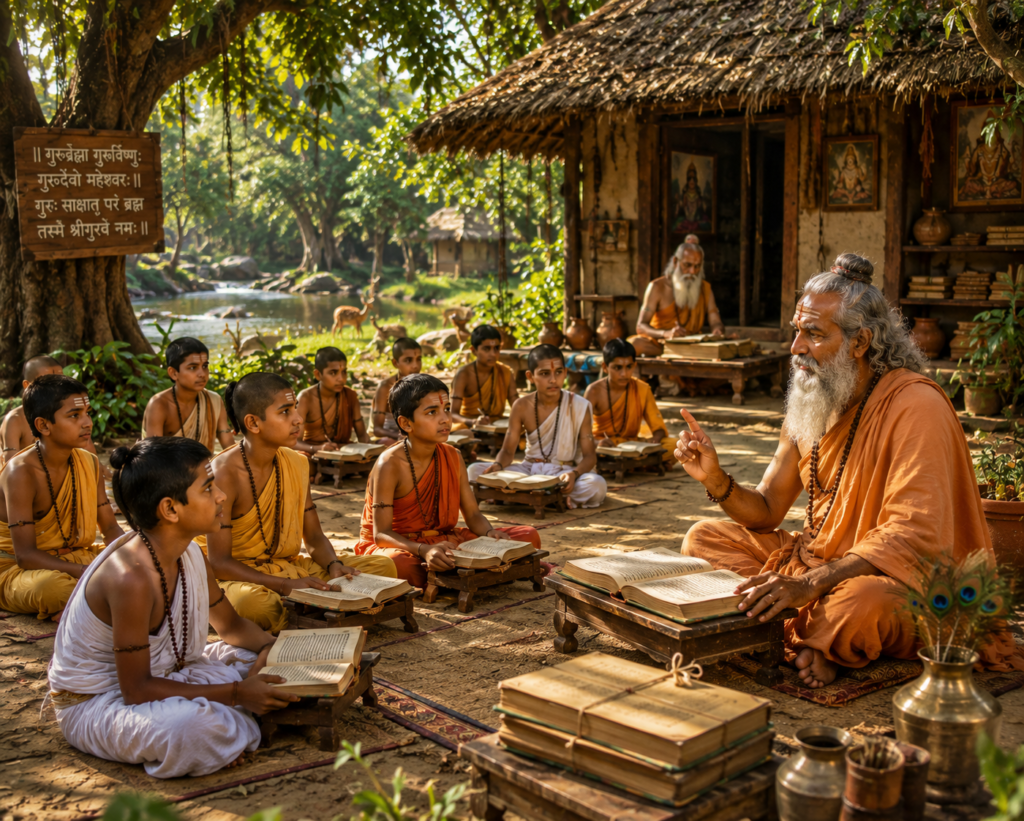
This thirst for Vedic knowledge guided the people of that era to approach the Vedic seers and sages. Consequently, many individuals during their youth (Brahmacharyashrama) began residing near the Rishis living in the forests to acquire the Vedic wisdom of Brahmavidya. In the hearts of the Rishis flowed a selfless stream of benevolence—gifting Brahmavidya for the ultimate material and spiritual welfare of all humanity. Simultaneously, a spring of faith flowed in the hearts of seekers eager to attain this supreme knowledge that bestows peace and joy. From the divine confluence of this stream of benevolence and spring of faith emerged a sacred tradition: the Guru-Shishya Tradition (Teacher-Disciple Lineage). The Rishi became the Guru, and those studying this divine Vedic wisdom under them became the Shishya (disciple). Through this Guru-Shishya tradition, the Gurukul was born. The foundational base of this Gurukul tradition—flowing for thousands of years and recognized as an indispensable pillar of Indian culture—was laid in the Vedic era. The sacred symbols of the Gurukul were drawn upon the courtyard of the Earth; its resonant drums sounded across the globe, echoing through the entire cosmos. The resonance of the Gurukul’s bell echoed through the pages of history so powerfully that its enduring reality is heard across the world to this day. Let us salute this very first, naturally celebrated “Opening Ceremony” of the Gurukul on Earth and welcome it with a thunderous round of applause! And a lighthearted note: a 100% guarantee of baldness for anyone who fails to clap—if you don’t clap, what else but lose your hair!
The word Gurukul literally means the family/lineage of the Guru. The word Kula signifies lineage or family. According to the scriptures, lineage is of two kinds:
वंशो द्विधा विद्यया जन्मना च।
“Lineage is twofold: by knowledge [Vidhya] and by birth [Janma].”
A disciple belongs to the Guru’s lineage through the acquisition of knowledge (Vidhya-vansha), while a son belongs to the father’s lineage through biological birth (Janma-vansha).
Our Indian culture accords primary status to the lineage of knowledge. The excellence of a disciple born through the lineage of wisdom is held higher than that of a biological descendant. This implies that even if a biological lineage continues, if the son remains devoid of true wisdom, he cannot achieve the ultimate good that a seeker born into the lineage of wisdom can attain—both materially and spiritually. For instance, the biological lineage of Guru Sandipani ended, yet Lord Krishna—born into his lineage of wisdom—conquered Yamaraja (the God of Death) and brought his deceased son back from Samyamani Puri, restoring his master’s physical lineage. Similarly, Guru Dronacharya held greater affection for his disciple Arjuna than for his own son Ashwatthama. Thus, in the dictionary of divinity, the lineage of wisdom holds greater validity than the lineage of birth.
This same truth is articulated in the Baudhayana Dharma Sutra:
द्वयमु ह वै सुश्रवसोऽनूचानस्य रेतो ब्राह्मणस्योर्ध्व नाभेरधस्तादन्यत् । स यदूर्ध्वं नाभेस्तेन हैतत् प्रजायते यद् ब्राह्मणानुपनयति, यदध्यापयति, यद्याजयति, यत्साधु करोति, सर्वास्यैषा प्रजा भवति । अथ यदवाचीनं नाभेस्तेन हास्यौरसी प्रजा भवति, तस्माच्छ्रोत्रियमनूचानमप्रजोऽसीति न वदन्ति ॥ (बौधायन धर्मसूत्र-१/१/१५)
“There are two vital energies/lineages in a master. One resides above the navel, expressing itself through speech in teaching, sacred initiation, conducting rituals, and righteous action; the children born of this higher energy are the disciples, endowed with extraordinary spiritual power. The second energy below the navel produces biological offspring. Therefore, a learned master who imparts knowledge is never considered childless, even in the absence of biological issues.”
Thus, a disciple is often dearer to a Guru than a biological son, granting the Guru the sacred joy of fatherhood. Because of this bond—a relationship far beyond blood relations—the foundation of the Gurukul became permanent and absolute. Ultimately, it is self-evident that: Gurukul means the Guru-Shishya tradition, and the Guru-Shishya tradition means Gurukul. They are synonymous. In short, the Gurukul tradition and the Guru-Shishya tradition are one and the same.
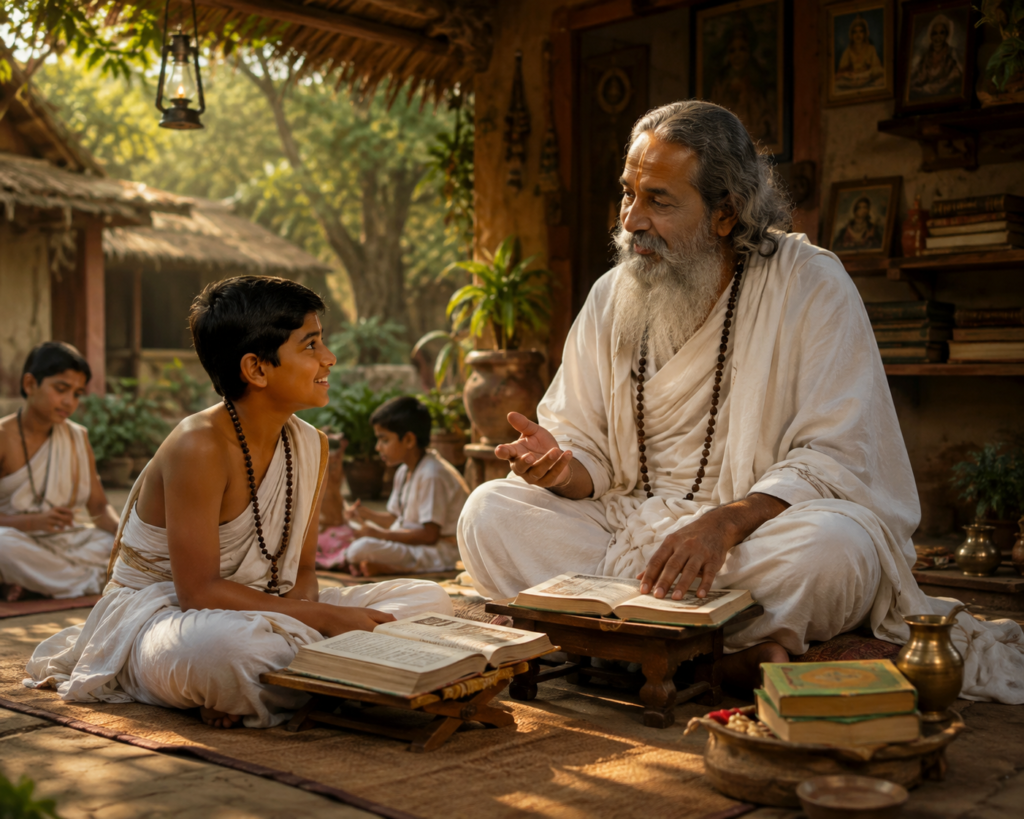
According to the Bhagavad Gomandal (Gujarati Lexicon), the word Gurukul has three primary meanings:
- The residence of the Guru; the teacher’s abode.
- An educational institution or seat of learning where students reside as family members in the Guru’s home according to the ancient system of education.
- A residential university with student quarters.
The terms residence, home, and abode used in all three definitions point to the Gurukul as a family home. Keeping students in the midst of worldly chaos and turmoil is harmful to their development, yet isolating them from a warm family atmosphere is equally detrimental. Therefore, they were distanced from the chaotic distractions of the world, but not isolated from a family environment. They stepped out of their small biological families into the expanded, noble family of the Guru—where the Guru became their parent and fellow disciples became their brothers.
From this perspective, the deeper meaning of a Gurukul is neither just a family unit nor merely an academic institution; it is the expansion of family spirit into the sphere of education. A school (Vidyalaya) is separate, and a home (Gruhalaya) is separate. But a Gurukul synthesizes both, imparting education with familial love within a home-like environment.
Numerous examples in the Vedas show that education in ancient India was imparted systematically by seers. Vedic literature notes that masters individually taught disciples in their Gurukuls, Ashrams, or hermitages. References from the Rigveda indicate that a Gurukul was an institution where education was imparted selflessly.
In his work ‘Bharat-Bharti’, the legendary poet Maithili Sharan Gupt describes the serene atmosphere of ancient Gurukuls :
मृग और सिंह गुरुकुलो में साथ ही फिरने लगे,
शुचि होम-धूप उठे कि सुन्दर सुरभि घन घिरने लगे ।
ऋषि-मुनि मुदित मन से यथा-विधि हवन क्या करने लगे-
उपकारमूलक पुण्य के भण्डार-से भरने लगे ॥
“Dear and lion wandered together in the precincts of the Gurukuls, Fragrant smoke arose from sacred offerings, weaving beautiful aromatic clouds. Rishis and sages performed holy sacrifices with joyful minds— Filling the realm with endless stores of benevolent merit.”
वे सौम्य ऋषि-मुनि आजकल के साधुओं-जैसे नहीं,
कोई विषय जिनसे छिपा हो विज्ञ वे ऐसे नहीं ।
हस्तामलक जैसे उन्हें प्रत्यक्ष तीनों काल हैं,
शिवरूप हैं, तोड़े उन्होंने बन्धनों के जाल हैं ॥
“Those gentle sages were not like modern ascetics; No subject remained hidden from their profound wisdom. Past, present, and future were as clear to them as a gooseberry in hand; Divine in form, they broke free from all worldly entanglements.”
वे ग्रन्थ जो सर्वत्र ही गुरुमान से मण्डित हुए-
पढ़कर जिन्हें संसार के तत्त्वज्ञ-जन पण्डित हुए ।
जो आज भी थोड़े-बहुत हैं नष्ट होने से बचे,
हैं वे उन्हीं तप के धनी ऋषि और मुनियों के रचे ॥
“The texts that were universally honored with supreme reverence— Reading which the scholars of the world became enlightened thinkers; Those works that remain preserved today from destruction, Were authored by those very Rishis, rich in penance and wisdom.”
कुशपाणि पाकर भी उन्हें डरता स्वयं वज्री सदा ।
है तुच्छ उनके निकट यद्यपि उस सुरप की सम्पदा ।
यद्यपि उटजवासी तदपि वह तत्त्व उनके पास है,
आकर अलेक्जेण्डर सदृश सम्राट् बनता दास है ! ॥
“Holding the sacred Kusha grass, even Indra feared their spiritual power, Though the wealth of the king of gods seemed trivial before them. Though dwelling in humble huts, they possessed the ultimate Truth— Before whom great emperors like Alexander came to bow as humble servants!”
विद्यार्थियों ने जागकर गुरुदेव का वन्दन किया,
निज नित्यकृत्य समास करके अध्ययन में मन दिया ।
जिस ब्रह्मचर्य व्रत बिना हैं आज हम सब रो रहे-
उसके सहित वे धीर होकर वीर भी हैं हो रहे ॥
“Awakening at dawn, students offered salutations to the Guru, Completing their daily routines, they immersed their minds in study. The vow of Brahmacharya, whose loss we lament today— Embracing it with patience, they grew into heroes of mighty strength.”
In these Gurukuls, an uninterrupted Yajna of knowledge took place under the guidance of wise Rishis. Studying was not a forced burden for the student, nor was teaching a commercial profession for the master. Rather, learning for the student and teaching for the Guru was a sacred duty—a divine Yajna. Every evening, a gathering (Sayam Sabha) was held for discussions on science, philosophy, and practical wisdom. Complete training in all life-essential arts was imparted. Through this holistic education, students developed multifaceted strengths. Equipping themselves with a practical and balanced perspective on life, they stepped into the world fully capable.
They understood the harmony of destiny (Prarabdha), personal effort (Purushartha), and prayer (Prarthana). Consequently, even while acquiring wealth and success in the world, they led pure, righteous lives, savored the bliss of inner liberation, and remained unattached at heart.
The core medium of this Gurukul—built upon the peaceful bond between master and disciple—was the selfless gift of education (Vidya-dana). That is why the mere word Gurukul makes our mind soar like a peacock to sing atop the peaks of ancient Indian wisdom.
- Gurukul was the soul of ancient Indian education.
- Gurukul was the foundation of ancient Indian education.
Through the knowledge disseminated from Gurukuls, Indian culture and society flourished. This Gurukul educational system formed the root of all social and cultural frameworks. Just as watering the roots of a tree nourishes its trunk, branches, leaves, and fruit, the Gurukul system served as the root of India’s economic, political, familial, and judicial structures.
With the strength of this Gurukul system, ancient India achieved all-round development.
Nourished completely by the Gurukul, India rose to its legendary grandeur—a golden era whose brilliance shines like a superstar to this very day.