The history of the Gurukul stands higher than the Himalayas, stronger than the Great Wall of China, and far more ancient than the Pyramids of Egypt. To melt away the wonder of why this glorious history—as majestic as the Godfather of the world—never became as famous or favorite as the founder of Facebook, let us pause our daily routine for a moment… Let us become companions of the past… Let us step off the balcony of our daily lives and take a stroll through the corridors of Gurukul history. The origin of the Gurukul is intrinsically linked to the very beginning of creation. At the dawn of creation, Lord Shri Narayana imparted the Vedas—the divine supreme knowledge – Brahmavidya to Lord Brahma.
In the Brihadaranyaka Upanishad, these Vedas are described as the very breath of the Supreme Being:
Change block type or style
Block Paragraph is at the beginning of the content and can’t be moved up
Move Paragraph block from position 1 down to position 2
Change text alignment
Displays more block tools
blob:https://connectgujarat.com/157620e0-382c-4456-876d-b3b7b4a0448aMeta Boxes
Use up and down arrow keys to resize the meta box pane.
अस्य महतो भूतस्य निःश्वसितमेतत् ।
यदृग्वेदः यजुर्वेदः सामवेदोऽथर्वांगीरसः ॥
(बृहदारण्यक उपनिषद्… २/४/१०)
“The Rigveda, Yajurveda, Samaveda, and Atharvaveda are like the breath of this Great Being.”
The Shvetashvatara Upanishad states:
यो ब्रह्माणं विदधाति पूर्वं यो वै वेदांश्च प्रहिणोति तस्मै ।
(श्वेताश्वतरोपनिषद्… ६/२)
“In the beginning of creation, the Supreme Being created Brahma and granted him the wisdom of the Vedas.”
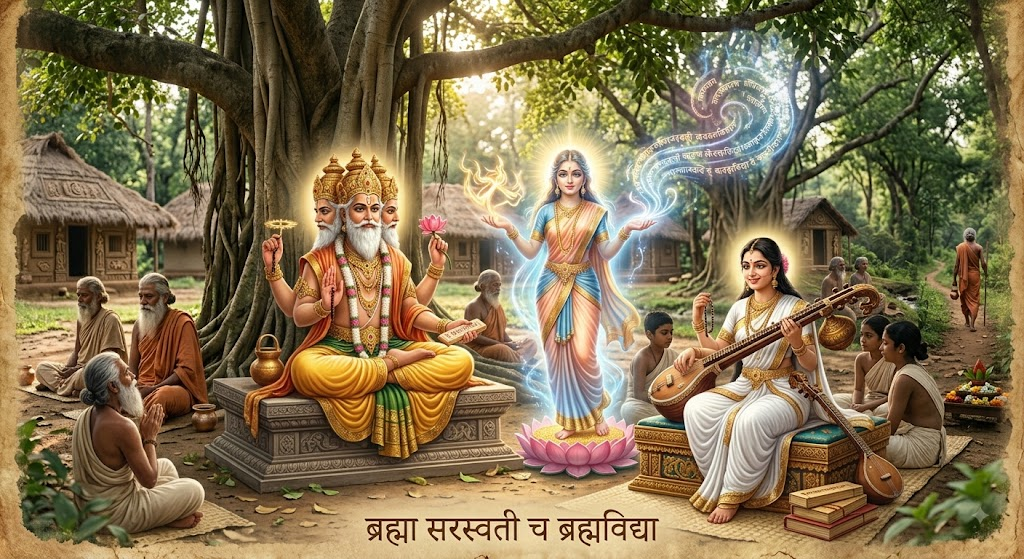
Thus, Brahmavidya began residing in Brahmaloka alongside Lord Brahma. One day, Goddess Brahmavidya, residing in Brahmaloka, addressed Father Brahma: “O Lord!… A resolve has arisen in my mind to take an incarnation upon the Earth.”
“It is a most auspicious resolve. Your descent upon the Earth will bring immense welfare to humanity. You have my blessings for this noble endeavor,” Brahma granted his permission.
Brahmavidya then asked: “O Father!… Please guide me: in what form should I incarnate upon the Earth?”
Lord Brahma replied: “O Goddess Brahmavidya! In whichever form you descend upon the Earth, my desire is that you bestow ultimate welfare upon endless souls for all eternity. Therefore, seek the answer to your question from Goddess Saraswati, the deity of knowledge. She knows best which form is most suitable for incarnating on Earth at this time.”
Goddess Brahmavidya turned her inquiring gaze toward Saraswati. Goddess Saraswati placed a finger upon the string of her Veena. A divine sound emerged from the Veena, and from that sound, words manifested: “I grant you my Vaak Swaroop (Embodiment of Speech). Established upon it, descend upon Bharatvarsha (India) on Earth in the form of the Divine Word (Shabda-deha), and reside there eternally according to the command of Father Brahma.”
“Sister Saraswati!… Having given form to my identity, please guide me on the process of descending upon the Earth,” asked Brahmavidya.
Goddess Saraswati explained: “First, enter the consciousness (Chitta) of the seers – Rishis of Bharatvarsha. Then, take the form of divine vibrations within their minds, and they will spontaneously receive the Vedic wisdom of Brahmavidya. Through this Vedic knowledge, the Rishis will gain the sacred, mysterious knowledge of the Supreme Entity (Param-tattva). This ‘mysterious knowledge of the Supreme Entity’ shall be considered your primary form on Earth. The Rishis are compassionate; possessing a sincere desire for the welfare of all humankind, they will not sit idle once this knowledge awakens within their consciousness. They will impart this Vedic knowledge—this Brahmavidya, the wisdom of the Supreme—to anyone who approaches them… And thus, Vedic Brahmavidya shall spread across the entire Earth.”
Thereafter, by the decree of Father Brahma and under the guidance of Goddess Saraswati, the Rishis of glorious India directly experienced the realization of Brahmavidya upon the Earth.
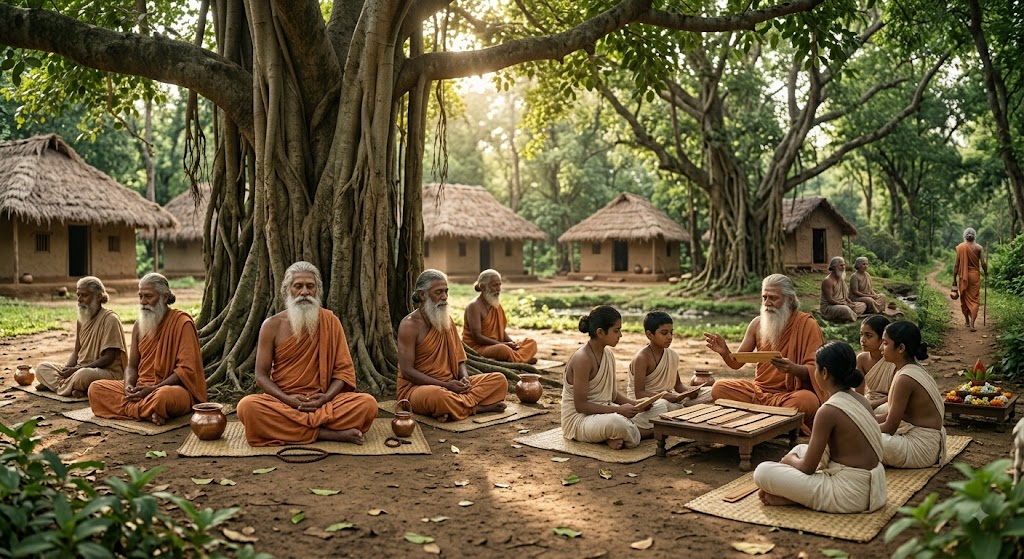
The Rishis—the seers of Vedic mantras, the creators of holy scriptures, those who lived lives of inner and outer purity, who showered pearls of auspiciousness upon the human mind, lit the tender flame of infinite inspiration, lived an inner life immersed in divine bliss, transcended the senses to experience deep meditation, possessed divine vision (Aarsha-drishti) through a pure, disciplined, and righteous lifestyle, worked for the welfare of every living being through thought, word, and deed, possessed a distinct perspective to witness the Divine, and lived like a lotus in water, meditating upon the platform of self-knowledge through penance—knew, understood, and accepted that every living soul has the right to receive the sacred knowledge of the Supreme. Capable of realizing the cosmic truth – Rut, these Rishis allowed the sacred river of Brahmavidya to flow between the two banks of knowledge and righteous character, bestowing boundless joy upon many. They began teaching this realized Brahmavidya—the wisdom of the Vedas—for the upliftment of all human society. Furthermore, the ancient Aryans of early India possessed an irrepressible zeal and drive to analyze original thought and engage their mental faculties. Therefore, they divided human life into four distinct stages, offering humanity the key to a complete and ideal lifestyle through a structured way of living. Each stage was named an Ashrama. These four Ashramas became vital components of human existence. Each phase was calculated at twenty-five years, contemplating a full lifespan of one hundred years:
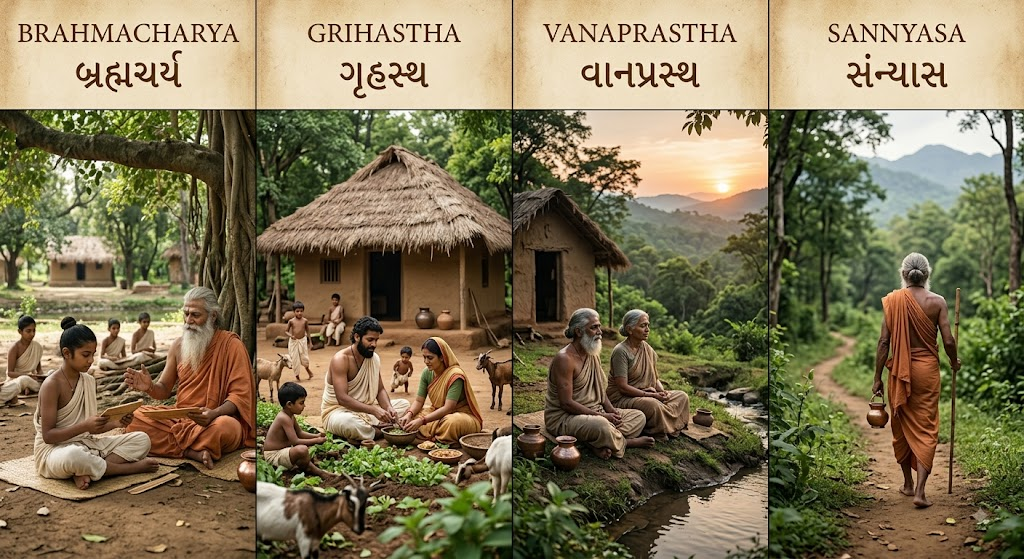
- Brahmacharyashrama (Student Life): The first stage, serving as the master key to a successful life, was dedicated to growth—from adolescence to youth—focusing on education, acquisition of knowledge, discipline, and self-control. During this time, the student donned the sacred thread (Upavita) and resided near the Guru in the Ashrama, serving the Master and pursuing spiritual and academic knowledge.
- Grihasthashrama (Householder Life): The second phase encompassed family life—from marriage and raising children to fulfilling social and worldly responsibilities. Upon completing education, a person married and entered the Grihasthashrama, spending the next twenty-five years in this stage. They welcomed guests, served their parents, earned a livelihood to sustain their children and family, and cared for domestic animals.
- Vanaprasthashrama (Retired/Hermit Life): After attaining material comforts and societal prosperity, the third stage provided a platform for selfless social service. Handing over family responsibilities to their sons, individuals devoted themselves to contemplation of the Divine and dedicated their lives to community service. They lived quietly, offering guidance derived from a lifetime of experience to their children, extended family, and community during difficult times. These seasoned individuals served as vital pillars and guides for the society.
- Sannyasashrama (Renunciate Life): The final stage involved renouncing all family, social, and worldly activities to embrace solitude, meditation, and spiritual devotion. A person surrendered all attachments, changed their identity, severed family ties, wore saffron robes, and lived the life of an ascetic. Embracing the ethos of Vasudhaiva Kutumbakam (“The whole world is one family”), they regarded the entire world as their home and all living beings as their family.
Looking closely at each stage of this system, it becomes clear that human beings recognized the essential need for wise Rishis during Brahmacharyashrama—the foundational pillar of life—to acquire true knowledge.
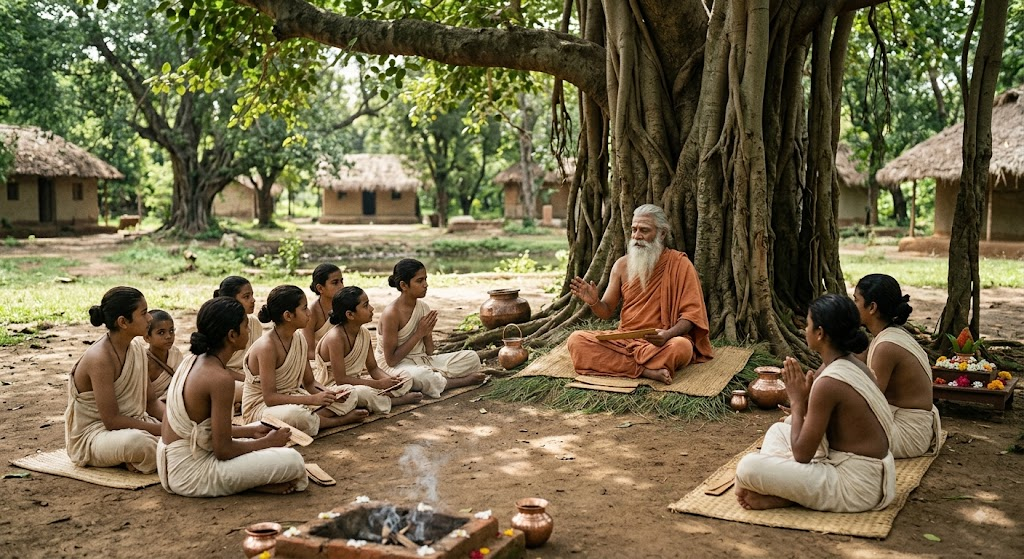
Furthermore, as their reasoning developed, human beings first observed the unimaginable beauty of Nature, experiencing both her gentle and formidable aspects. This filled them with joy, awe, and a sense of wonder mixed with confusion as they struggled to comprehend Nature. Questions arose within their minds: What is all this? Who created it? Why was it created? Influenced by a sense of wonder, reverence, and fear of the unknown, humanity naturally began searching for the Creator of the universe. This quest led them to the enlightened, Brahmavidya-wise Rishis who were immersed in the bliss of the Supreme Entity. A deep desire awoke within humans to receive the knowledge of the Creator—the knowledge of Brahmavidya—from these Rishis. Consequently, a natural respect and faith blossomed toward these wise seers, giving birth to a profound bond of friendship between humanity and the great sages.