
The foundations of the Vedic-era Gurukuls were gurus of the highest order—spiritual Rishis, Munis, and Saints. The definition of a Rishi is given as: “ऋषति – गच्छति संसारपारम् इति ।” (“A Rishi is one who moves beyond the ocean of worldly existence.”)
A Rishi possesses a clear vision of human well-being, both in this world and the world beyond. A Rishi is a true spiritual kin and trusted guide of humanity. This is because, being completely unchoked by the cycles of attachment and aversion (Raga-Dvesha), a Rishi never speaks untruthfully—meaning, they never offer empty, shallow, or false advice to anyone.
There is the power to transform humanity within the contemplation of a Rishi, because a Rishi’s intellect is wholly surrendered to God. A Rishi considers himself not the creator of a mantra, but the seer of the mantra… ‘ऋषयः मंत्र द्रष्टारः, न तु कर्तारः ।’
A thought born of human intellect may or may not change a person, but a thought manifested through divine grace within a God-surrendered Rishi’s intellect can change all of humanity—this is an unquestionable truth.
They regarded the knowledge received from the Supreme Entity as the very form of God Himself. They never stamped a mark of personal ownership upon their words, nor did they ever claim to be an fathomless ocean of knowledge. They accepted themselves merely as seers (Drashta) and offered all credit to the Supreme Lord. Only one who considers oneself a mere instrument (Nimitta) is truly called a Rishi.

The word ‘Rishi’ (ઋષિ / ऋषि) itself is worth understanding. ‘Ri’ (ऋ) means ‘to let go’ or ‘to surrender’, and ‘Shi’ (षि) means ‘to become steady’. Those who let go of all three qualities (Gunas), become liberated, and establish a calm, steadfast oneness with the Supreme Consciousness… are Rishis.
लौकिकानां हि साधूनामर्थं वागनुवर्तते । ऋषीणां पुनराद्यानां वाचमर्थोऽनुधावति ॥
Ordinary, worldly good people think of the meaning first and then speak—’Think before you speak’. However, behind the primordial Rishis, meaning itself comes running. It is as if the meaning considers it its own supreme fortune to ride upon the speech of such great souls!
Because: यास्तेषां स्वैरकथाः ता एव भवन्ति शास्त्राणि । “Even the casual, spontaneous conversations of such great souls assume the form of scriptures.”
The utterances of such great personalities are poetry itself.

There is a definition of the Veda: अपौरुषेय वाक्यं वेद । (“Apaurusheya sentences are called Vedas.”) The primary meaning is that Apaurusheya refers to sentences created not by any human being (Purusha), but by the Supreme God Himself… such statements are the Vedas.
To understand the second meaning of Veda, let us look at the root of the word Rishi. The word Rishi originates from the root ऋष् (Rish). It signifies movement, revelation (Shruti), truth, and austerity (Tapas). The knowledge of the Vedic mantras was attained by Rishis through inner intuition.
देवानाम यत उच्छ्वासितम् तद् ऋग्वेदः यजुर्वेदः सामवेदः अथर्ववेदश्च । (That knowledge which was naturally obtained as an exhalation by those whose consciousness had become divine is the Rigveda, Yajurveda, Samaveda, and Atharvaveda.)
Effortlessly received knowledge means knowledge gained without artificial effort. Paurusha means human effort; Apaurusheya means without human effort. Yet, the Rishis did exert effort here—not an external effort, but a subtle movement inward toward the inner self, resulting in divine sight (Divya Drishti)! Therefore, the second meaning of Veda is the knowledge effortlessly received by Rishis through inner stillness. That is precisely why Rishis are called seers of mantras, not creators or authors of mantras!… ऋषयोः मन्त्र द्रष्टारः ॥
The effort behind the creation of the Vedas is internal, and that is precisely why it is divine! Yaskacharya says: ऋषि दर्शनात् । (“One is called a Rishi because of having seen the Vedic mantras.”)
A Rishi feels heartfelt love for human society. A Rishi considers the entire universe as belonging to his Lord. Just as a devoted wife endeavors to keep her husband’s house clean and beautiful, a Rishi endlessly strives to keep the world—the home of his Lord—pure and sacred. His social service or global transformation is born directly from the womb of devotion, and its foundation is love for the Divine.
The downfall of the world causes grief to a Rishi; his heart cries out. But because there is no selfishness hidden within this weeping, it is considered a sacred sorrow (Vishada Yoga). At times, these Rishis may even appear annoyed with a fallen society, but that irritation springs from deep love. It is a simple truth: without love, there is no irritation. A father gets irritated seeing his own son’s downfall, not the neighbor’s. The weeping of a person who cries for human growth is called Vishada Yoga, and the anger of a person who becomes agitated upon seeing the cultural degradation of the world is considered righteous indignation (Punya Prakopa). The sorrow of such a human becomes a verse (Shloka), and his anger turns him into a contemplative philosopher.
Our Rishis are the very embodiment of the collective cultural soul. A human’s ordinary understanding is intellect (Buddhi), while deep, intuitive vision is wisdom (Prajna). Being endowed with Prajna, the Rishis who founded the Gurukuls guided the world toward the path of liberation (Moksha).
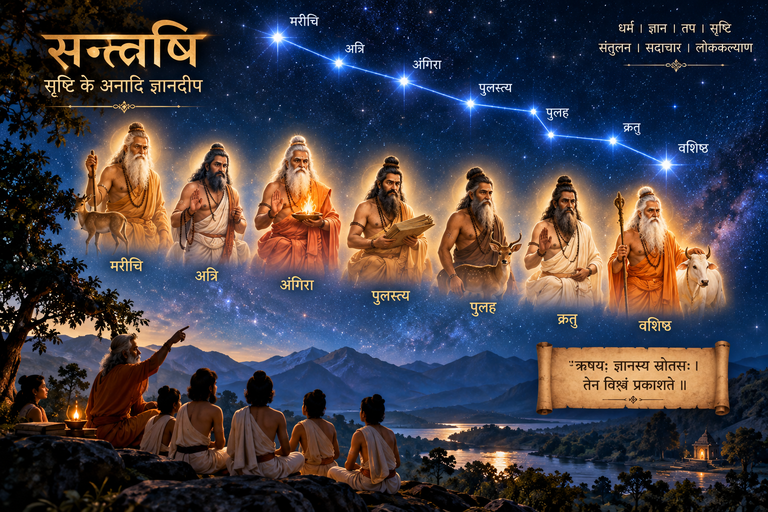
Types of Rishis:
These Rishis residing on the spiritual heights of the Gurukul were positioned according to their penance, sacrifice, and spiritual achievements.
First, remembering the Saptarshis (Seven Sages)… Atri, Vashistha, Kashyapa, Gautama, Bharadvaja, Vishvamitra, and Jamadagni (the son of Mahatma Ruchika) are considered worthy of the honor of Saptarshi. This is because they attained complete perfection through discourse and spiritual power, and they consciously observed the vow of lifelong celibacy (Naisthika Brahmacharya). A Saptarshi must also possess seven key qualities: long life, being a mantra-revealer, being powerful like God, possessing foresight, directly experiencing truth through intellect, maintaining a noble lineage, fully accepting all classes (Varnas) and stages of life (Ashramas), and being devoted to truth and righteousness… Only such supreme builders of the global sacrifice (Vishwa-Yajna) could find a place among the Saptarshis.
Culture never develops through governance alone; rather, culture is born from those who understand the difference between duty (Karya) and non-duty (Akarya), lead society along the path of truth, and shape human life. Such Rishis were called Brahmarshis. Bhrigu, Angira, Vamadeva, Yajnavalkya, Kapila, Vashistha, etc., are Brahmarshis because they are seers of the path of knowledge (Jnana Marga). In terms of the fourfold order, they belong to the Brahmin class. They are metaphysicians, meditating on the Supreme (Brahma), remaining busy in the quest for Ultimate Reality, formulating new principles to present before the people, and explaining their inner significance and importance. Brahmarshis are essential to convey the awareness of spiritual power. Brahmarshis serve as the foundational bricks in making social life elevated, radiant, and cultured, and in strengthening the pillars of culture. It is their seer-vision (Aarsha-drishti) that illuminated the path of human life. They are the Rishis who urged society to follow the supreme truth.
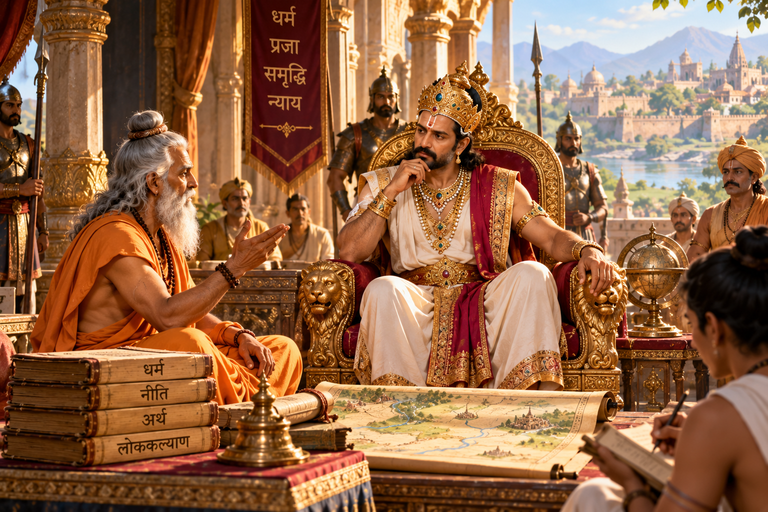
Those Rishis who possess original insight and spiritual vision along with a higher readiness to serve society are Rajarshis. A Rajarshi is an action-oriented seer (Karma-yogi Drashta). The role of Rajarshis is to live within society and guide it along the right path. In terms of social organization, they belong to the Kshatriya lineage. If a Brahmarshi is the teacher, a Rajarshi is the protector. Protecting society, removing evils, safeguarding society from corrupt speech, thought, and behavior, and nurturing people’s good deeds becomes the sacred duty of a Rajarshi.
Having cultivated a vision to see the world in its true, authentic form through their foresight and personal experience, Rajarshis are well-wishers of the people. They actively strive to enhance the happiness of the citizenry because they voluntarily accept this responsibility. A Rajarshi is one who spends his life keeping the social order refined, healthy, and clean. Always ready to gather knowledge of the people’s condition from every home and take appropriate action, a Rajarshi’s permanent heart-feeling is empathy. Experiments and efforts to build a neat, cultured society form the unique penance of Rajarshis. Agastya, Vishvamitra, Lord Manu, Janaka Videhi, etc., attained the honor of Rajarshi.
Furthermore, personalities like Sage Parashara were called Paramarshis, while Charaka, Sushruta, etc., were known as Shrutarshis.
Meanwhile, Bhrigu, Marichi, Angira, Pulaha, Pulastya, Kratu, Vyasa, etc., are revered as Maharshis. Indian culture remains rich and luminous through figures like Shukracharya, Chyavana, Uttathya, Aushija, Kardama, Vishrava, Shakti, and the Valakhilyas.
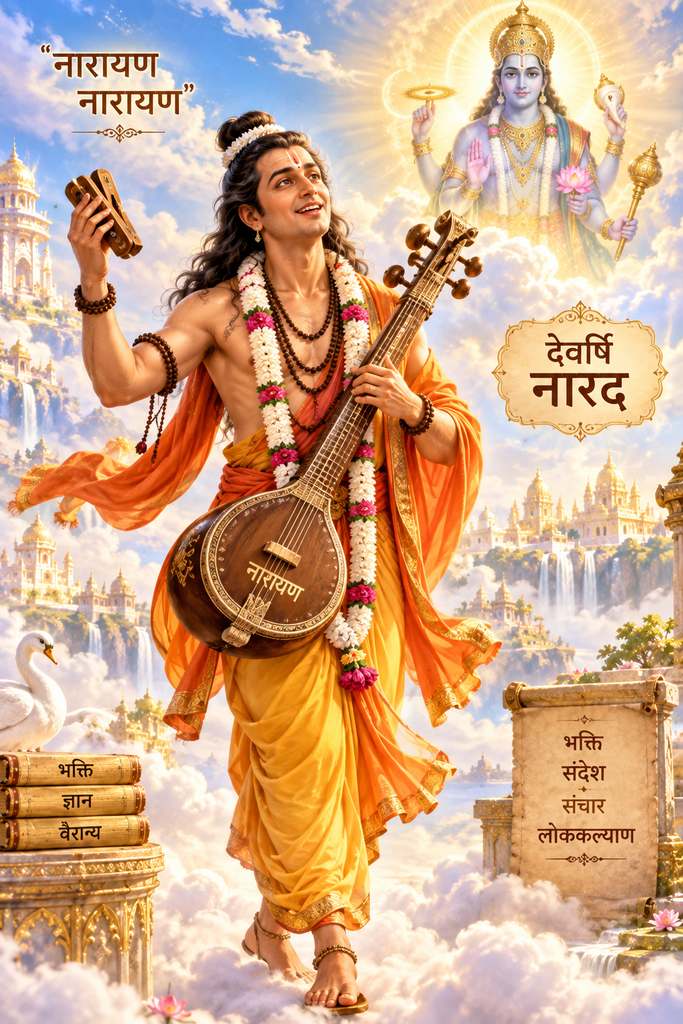
Among all of these, when we speak of Devarshi, Sage Narada immediately fills our mind. This seer of the path of devotion (Bhakti Marga) is a Rishi who worships God in personal form (Saguna Rupa); yet his devotion is not blind, but alert and vision-endowed. He never tires of singing the praises of God, yet he leaves no stone unturned in explaining the truth even to the celestial gods. A perpetual traveler, successful dynamic worker, and messenger, Narada—being clear-minded and endowed with pure vision—neither strays from the path of truth nor allows anyone who comes into contact with him to stray. A lover of literature, a poet at heart, a musician, and an artist, the environment surrounding this Devarshi resounds continuously with divine praise, making his presence ever peaceful, healthy, joyful, and endearing. He possesses the capacity to visualize and bring forth the direct form of God. Able to manifest the beginningless, endless, unmanifest God, he is called a ‘Devarshi’.
What is the work of this Devarshi? The development of arts. A human being who has gained vision through the Brahmarshi and lives in a healthy society maintained by the Rajarshi can blossom in the fine arts. Devarshi’s deep yearning is for the world to become artistic, vibrant, and alive; hence, the melody of his lute (Veena) named Mahati continuously resonates alongside him. Just like Narada Ji, Vyasa Ji’s noble son Shukadeva Ji attained knowledge while still in his mother’s womb and achieved the status of Devarshi.
Truly, these Rishis—as teachers, protectors, and nourishers—are travelers on the supreme path. Praising them might be like small mouths speaking big words, yet one thing must be stated without fail: these Rishis, who labored tirelessly to create heaven right here upon the earth, flowed the Ganga of knowledge while presiding as Gurus in the Gurukul.