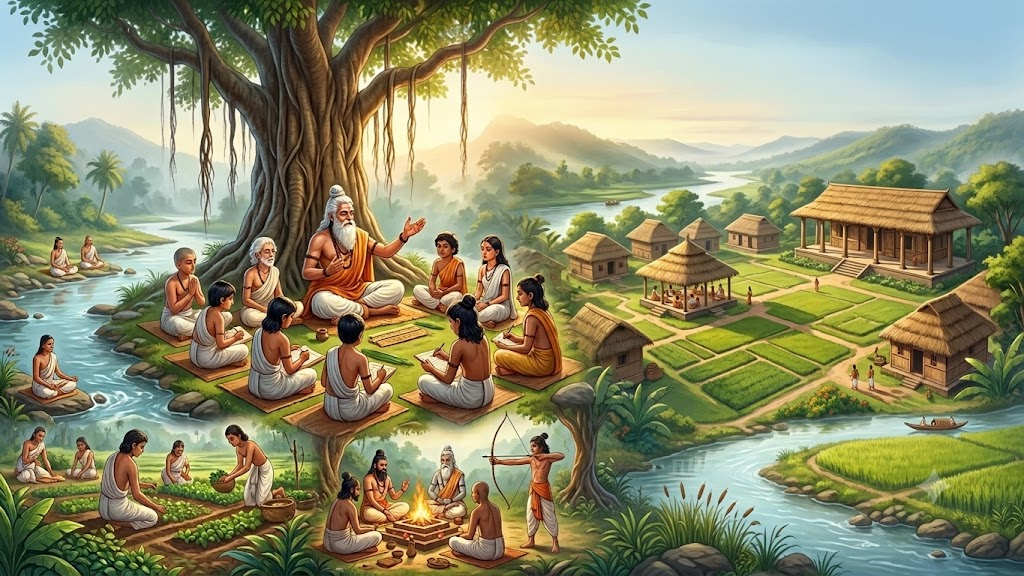
Before education commenced in the Gurukul, rituals and rites of passage (Samskaras) such as Mundan (tonsure/head shaving) and Upanayana (sacred thread ceremony) were performed… These Samskaras hold immense significance in our Indian culture… What is a Samskara? A Samskara means to refine, to purify, and to make something fit for use… When does a grain of Bansi wheat become large, plump, and lustrous like a gem? Only when we subject it to various refinement processes. After being harvested from the field and brought to the threshing floor, it must undergo a series of systematic purification processes before that wheat becomes fit for consumption… In the exact same manner, after a child undergoes various religious Samskaras and formally studies the Vedas in the Gurukul, he enters the Grihasthashrama (householder stage). Only when such a refined householder discerns between duty (Karma) and non-duty (Akarma) and engages in righteous actions does brilliance blossom in his household life—a brilliance whose reflection leaves a beautiful imprint on society. Therefore, in the Gurukuls of the Vedic era, rituals such as Mundan and Upanayana were performed before education officially began.
Mundan (Tonsure) and Mekhalabandhan :
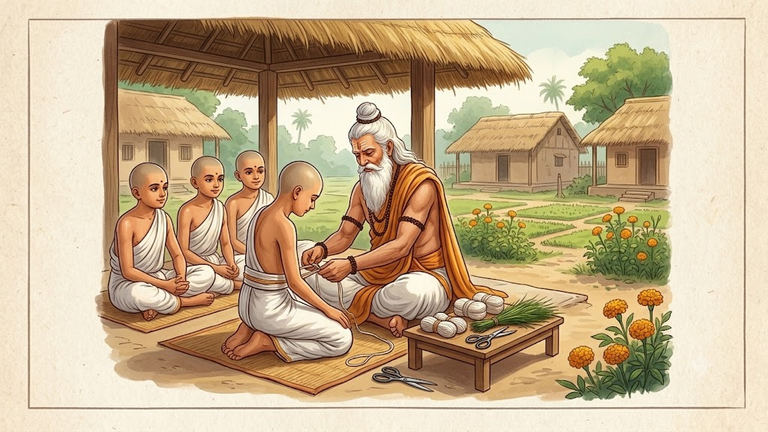
After the birth of a child, scriptures prescribe performing various Samskaras such as Jatakarma, Namakarana, Annaprashana, Chudakarma (Mundan), and Mekhalabandhan. Among these, the tonsure of the son’s head prior to beginning education was considered a vital rite of passage. Sage Atharva describes this in the 6th Kanda, 68th Sukta of the Atharvaveda:
“This is Lord Savitr, who has arrived with a razor to perform the tonsure of my son. O Lord Vayu, bring warm water. May the twelve Adityas, eleven Rudras, and eight Vasus become attentive and moisten the head of this son. O wise Prachetas, perform the tonsure of this son’s head, who himself exists in the form of King Soma.”
“O Mother Aditi, shave the facial hair and head of this son. O divine waters, moisten the hair with your luster. O Lord Prajapati, treat the body of this child well, so that he may be blessed with foresight and long vision.”
“With the razor that the wise Savitr used to shave King Varuna and King Soma; with that very razor, O Brahmarshi who knows the Vedic mantras, perform the tonsure of my son, so that he may prosper with cattle, horses, and progeny.”
Even in a rite like Mundan, a divine feeling was infused.
Later, as the child grew older, a sacred cord (Mekhala) was tied around his waist. Regarding this Mekhalabandhan Samskara, Sage Agastya states in the 6th Kanda, 133rd Sukta of the Atharvaveda:
“The Acharya/Guru who initiates me into the Gayatri Mantra for Brahmacharya (celibate studenthood) is my deity, who has bound this girdle (Mekhala) around me. He who has prepared me to acquire knowledge, who has tied me to vows—may that deity, by whose blessings we conduct all our affairs, desire to lead us across the ocean of knowledge and liberate us from the bonds of ignorance.”
“O Mekhala, we invoke you with love and honor you with affection; for you keep our life within moral boundaries. You are the unfailing weapon of the visionary Sages. You have been tied to help us maintain life’s vows. Destroy those enemies who create obstacles in our vows and education.”
“I have no fear of death, for I am a celibate student (Brahmachari) belonging to death itself. Thus, from this living world, I have chosen a man for death; not only that, but I bind that man with this girdle using the means of sacred mantras, penance, self-study, and hard labor. In other words, this student, practicing sacred knowledge, penance, and hard work while bound with the girdle, transcends death.”
“This girdle is the moral boundary of my life; it is the daughter of faith (Shraddha), born of penance (Tapas), and the sister of the Sages who created all beings. O Mekhala, grant us noble intellect and memory power. Grant us the power of penance and the strength of the senses… O Mekhala, ancient ascetics and sages wore you; embrace me so that I may live a long life.”
The student received the Mekhalabandhan Samskara in the presence of his parents before departing for the Gurukul. There, the Acharya became his father and the Gayatri Mantra became his mother. This was considered his second birth. He became a Dwija (twice-born) and enriched his life by acquiring knowledge.
Upanayana Samskara :
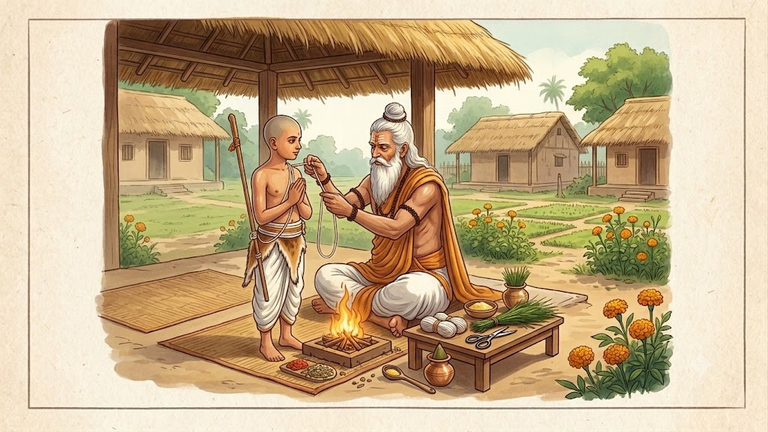
The Upanayana Samskara was indispensable for formal education. Just as no one can become a Christian without Baptism or a Muslim without the Kalima, in the Vedic era, no child or student could acquire knowledge without undergoing the Upanayana ceremony.
The Upanayana ritual is mentioned in the Rigveda:
देवा एतस्यामवदन्त पूर्वे सप्तऋषयस्तपसे ये निषेदुः ।
भीमा जाया ब्राह्मणस्योपनीता दुर्धां दधाति परमे व्योमन् ॥ (ऋग्वेद:.. १०/१०९/४)
Sage Yajnavalkya mentions the Upanayana ritual, saying:
उपनीय गुरुः शिष्यं महाव्याहृतिपूर्वकम् ।
वेदमध्यापयेदेनं शौचाचारांश्च शिक्षयेत् ॥ (याज्ञवल्क्य स्मृति… १/१५)
Sages Apastamba and Bharadvaja consider the main purpose of Upanayana to be the attainment of knowledge. For this reason, in the Gurukuls of that era, a student-disciple could begin his studies only after the Upanayana ceremony. In modern terms… obtaining admission to a Gurukul without Upanayana was impossible.
Literally, ‘Upanayana’ means ‘bringing near’—that is, bringing oneself near the Guru for education. Hence, Upanayana signifies approaching a Guru for learning. Mostly, a Rishi or Maharshi would perform the thread ceremony for children in his expansive Gurukul. A Brahmin child was given the sacred thread at the age of eight, a Kshatriya at ten, and a Vaishya at twelve. This clearly indicates the age at which education began in the Gurukul.
Through Upanayana, the disciple became a ‘Dwija’. The first birth was from the mother’s womb, and the second birth was at the hands of the Guru. During the Upanayana ritual, the Guru bestowed the sacred thread (Janoi) upon the disciple.
वसन्तो ग्रीष्मश्चरदित्यृतवो वर्णानुपूर्व्येण ॥ (आपस्तम्ब गृह्यसूत्रम्… १०/४)
“The Upanayana ceremony should be performed in the Spring season for a Brahmin, in the Summer season for a Kshatriya, and in the Autumn season for a Vaishya…”
At the time of Upanayana, the Gayatri Mantra was prescribed for a Brahmin, the Trishtubh Mantra for a Kshatriya, and the Jagati Mantra for a Vaishya…
गायत्या ब्राह्मणमसृजत त्रिष्टुभा राजन्यं जगत्या वैश्यं ॥ (बौधायन धर्मसूत्रम्… १/२/१२)
A three-strand cotton thread (Janoi) was given to a Brahmin student, a similar hemp thread to a Kshatriya, and a wool thread to a Vaishya. The strands of all sacred threads were twisted to the right.
In the Upanayana ceremony, the Guru transformed the child into a Brahmachari—one whose conduct aligns with the path to realizing the Supreme (Brahm). Once the Guru gave the sacred thread, the child was considered a “student/scholar.” In the scriptures, he was called a ‘Brahmachari’.
ब्रह्मचारी ब्रह्म भ्राजद्विभर्ति तस्मिन्देवा अधि विश्वे समोताः ।
प्राणापानौ जनयन्नाद्व्यानं वाचं मनो हृदयं ब्रह्म मेधाम् ॥ (अथर्ववेद… ११/५/२४ )
“The radiant Supreme and all the deities reside within the Brahmachari who observes celibacy and sacred discipline.”
आचार्य उपनयमानो ब्रह्मचारिणं कृणुते गर्भमन्तः ।
तं रात्रीस्तिस्र उदरे बिभर्ति तं जातं द्रष्टुमभिसंयन्ति देवाः ॥ (अथर्ववेद… ११/५/३ )
“After performing the Upanayana ceremony, the Guru holds the disciple within his womb. He keeps him in his belly for three nights. Then, when that disciple is born, the gods gather to behold him.”
Upon completing the Upanayana ceremony, the secret Guru Mantra was imparted to the student; this secret initiation was never given to an unqualified student. After receiving this initiation, the student-brahmachari became eligible for Vedic studies.
बालः कृतोपनयनो वेदाहरणतत्परः ।
गुरूर्गृहे वसेद्भूय ब्रह्मचारी समाहितः ॥ (बौधायन गृह्यसूत्रम्… १/२/४२)
Having completed Upanayana and observing the vows of Brahmacharya, the student resided in the Guru’s home (Gurukul) with composure and acquired knowledge across various subjects. A student’s entry into the Gurukul was considered his second birth—a glorious event in his life.
The Commencement of Vedic Studies (Vedarambha) :
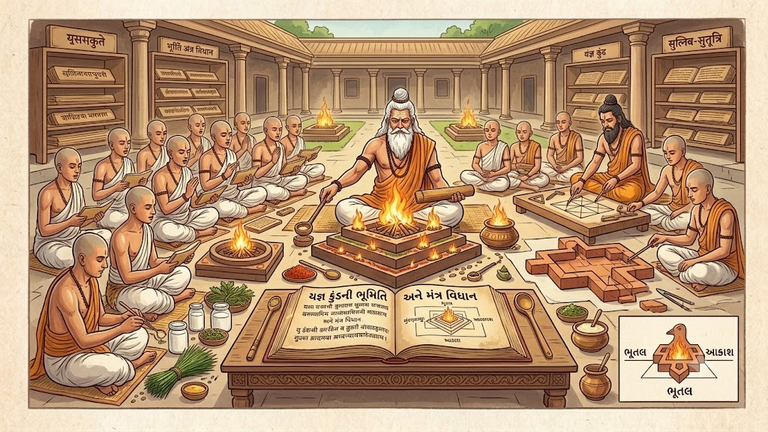
Vedic studies commenced on the full moon day of the month of Shravana (Shravani Poornima or Baleva), under the Shravana nakshatra. Therefore, if the auspicious time for Upanayana occurred earlier, the Brahmachari learned the morning and evening prayers (Sandhyavandanam) in the Gurukul and practiced them daily without fail. As commanded by the Guru, he served the sacrificial fire in the Yajnashala, gathered flowers for divine worship and rituals, went out to collect alms (Bhikshatan) morning and evening, tended to cows, and collected sacred firewood (Samidha). To keep the firewood insect-free, it was dried in the sun for two days after being gathered. The sacred firewood came from trees such as Palasa, Khair, Apamarga, Audumbara, Peepal, Peepar, Banyan, or Shami. They were twelve finger-lengths long, as thick as a little finger, dry, and with their bark intact. Serving through Samidha collection was regarded as a supreme form of service.
On the day Vedic studies commenced after Upanayana, the Acharya (Guru) sat near the Vedarambha altar. After performing ceremonial sipping of water (Achamana), breath control (Pranayama), and remembering his chosen deity, he established the sacred fire following the Pancha-bhu-samskara rites. Thereafter, chanting the designation of time and place (Deshakala), he took a solemn vow (Sankalpa): ‘अस्तु वटोर्यजुर्वेदादिक्रमेण वेदारम्भं करिष्ये’ (“I shall now begin the study of the Vedas, starting with the Yajurveda for this celibate student”).
Following the Vedarambha-havan, Svishtakrit-havan, and Sansrava-prashana rituals, the Guru offered a full vessel (Purna-patra) to Brahma and other deities and sought their blessings. Then, the Brahmachari worshiped Lord Ganesha, other deities, and his Guru before commencing his study of the Vedas.
Seating the Brahmachari on East-facing or North-facing Kusha grass, conducting smarta worship, pranayama, and brahmanjali, the Guru taught the complete Gayatri Mantra along with the sacred syllable Om and the Vyahritis. He then initiated the study of the student’s traditional Vedic branch (Swa-shakha).
From the day Vedic studies began, the student-brahmachari was called a ‘Manavaka’.
यच्छाखीयैस्तु संस्कारैः संस्कृतो ब्राह्मणो भवेत् ।
तच्छाखाध्ययनं कार्यमन्यथा पतितो भवेत् ॥
अधीत्य शाखामात्मीयां परशाखां ततः पठेत् ।
पारम्पर्यगतो येषां वेदः सपरिबृंहणः ॥
तच्छाखं कर्म कुर्वीत तच्छाखाध्ययनं तथा ।
एवमध्ययनं कुर्वन् ब्रह्मसायुज्यमाप्नुयात् ॥
(वसिष्ठ-वीर मित्रोदय… संस्कारप्रकाश… भाग-१, पृष्ठ-३३८)
“Initially, a student must study the Veda of his own branch. Studying another branch right at the beginning causes the student to fall from grace. Furthermore, after studying one’s own branch, one may study the branches of other Vedas. A student who pursues Vedic studies systematically in this manner attains communion with the Supreme (Brahma-sayujya)…”
After the commencement of Vedic studies, the student once again recited the entire Gayatri Mantra with Om and the Vyahritis, said ‘ॐ विरमोऽस्तु’ (“Om, may we pause now”), and bowed to the Guru by touching his feet. For the complete fulfillment of the Vedarambha ceremony, the student offered monetary offering (Dakshina) to the Acharya according to his capacity, and the Acharya blessed the student. Subsequently, the student’s father hosted a feast for the Acharya-Guru and all the fellow students residing in the Gurukul.
Once Vedic studies began, a student had to spend a minimum of nine years and a maximum of twelve continuous years in the Gurukul to study one of the four Vedas along with its auxiliary disciplines (Vedangas). Returning home during this period was not permitted; if a student left for home, his education would have to restart from the very beginning. For this reason, on the day Vedic studies commenced—Baleva—sisters tied a Rakhi on their brother’s wrist as a prayer for his smooth and successful twelve-year journey ahead.