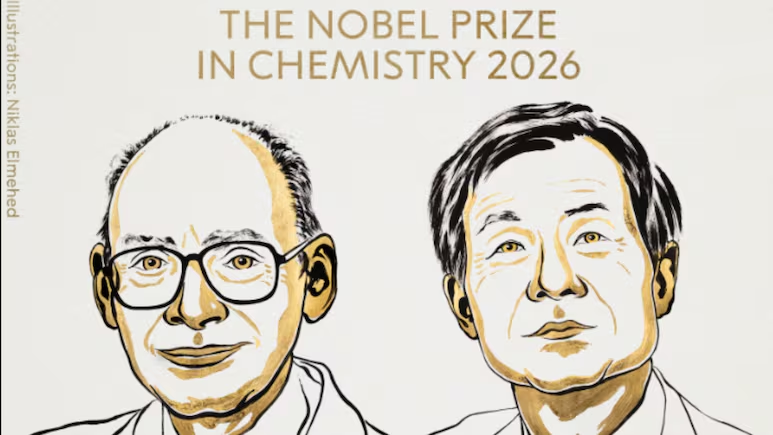
French chemist Henri B. Kagan and Japanese scientist Kenso Soai have been awarded the 2026 Nobel Prize in Chemistry for their pioneering work on asymmetric organic synthesis.
The Royal Swedish Academy of Sciences announced that the scientists were honoured “for the discovery of non-linear effects and autocatalysis in asymmetric organic synthesis.” Their research has helped scientists understand how chemical reactions can produce one preferred version of a molecule when two mirror-image forms are possible.
Solving a Century-Old Chemistry Mystery
Many molecules exist in two forms that are mirror images of each other, much like a person’s left and right hands. These forms are known as chiral molecules.
A major mystery in chemistry was why living organisms almost exclusively use only one of these two forms. This phenomenon is called homochirality.Kagan made an important breakthrough in 1986 by showing that chemical reactions could be manipulated to produce a greater amount of one molecular form. Soai later took the research further and developed an important form of asymmetric autocatalysis. In 2003, his experiments demonstrated a chemical reaction capable of producing essentially one molecular mirror image.
Importance for Medicines
The discovery has major applications in pharmaceutical research. Some medicines contain molecules that have two mirror-image forms, but the two forms can have very different effects in the human body.Being able to selectively produce the desired form can therefore make drug development more precise and potentially safer. The researchers’ work has provided important tools for chemists involved in designing and manufacturing pharmaceutical compounds.