The Indian climate is superior to that of all other countries in the world. The reason for this is that only in India does a major seasonal cycle of four distinct seasons function with regular order. As grand and enchanting as the external aspect of this highly fortunate land of Bharata (Bharata-khanda) is, its inner beauty is equally delightful and radiant. For India, enshrined in the eternal words of the timeless scriptures, is like a magical Parasmani (philosopher’s stone) placed on the measuring glass of purity. Western nations that sit upon the imperial throne of comfort regarding pizzas and visas cannot even secure passing marks on the test of purity. India, on the other hand, is the guiding torchbearer on the path of purity… The credit and purpose of spreading civilization throughout the entire world are embedded deep within the foundation of this nation.
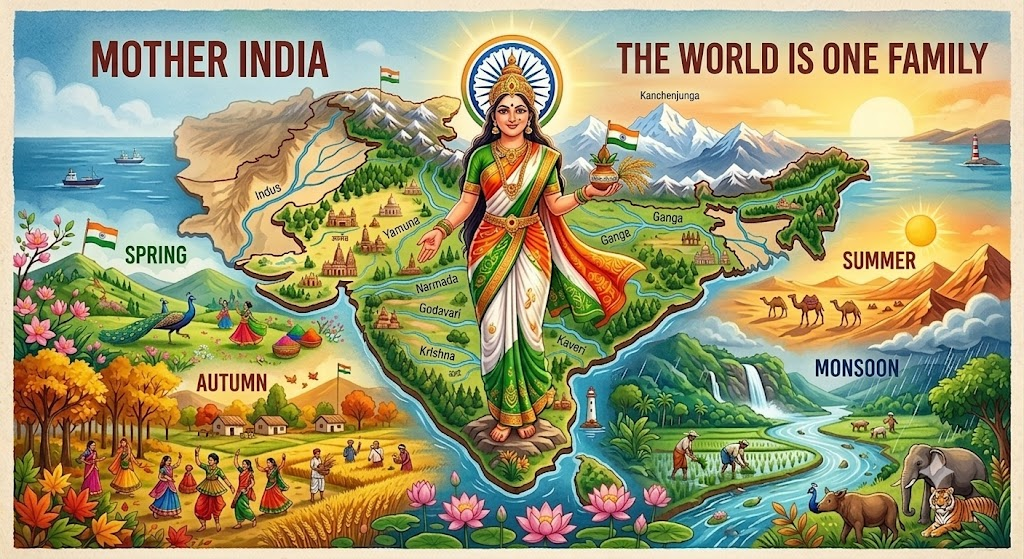
In the whole world, India is the only country blessed with the title of “Mother.” Indians are fortunate to be able to say with pride: “Bharat Mata ki Jai” (Victory to Mother India)… In reality, India is the mother of the entire world… Human beings were born from the womb of Mother India, nurtured in her lap, and developed through the nourishment provided by her. Will Durant, the renowned American historian and philosopher, noted: “India was the motherland of our race, and Sanskrit the mother of Europe’s languages: she was the mother of our philosophy; mother, through the Arabs, of much of our mathematics; mother, through the Buddha, of the ideals embodied in Christianity; mother, through the village community, of self-government and democracy. Mother India is in many ways the mother of us all.” Both global and Indian texts acknowledge that human origins lie in India. The human population on Earth descended from the sons of Prajapati; every human on Earth is an offspring of Prajapati. The very first human creator was Svayambhuva Manu.
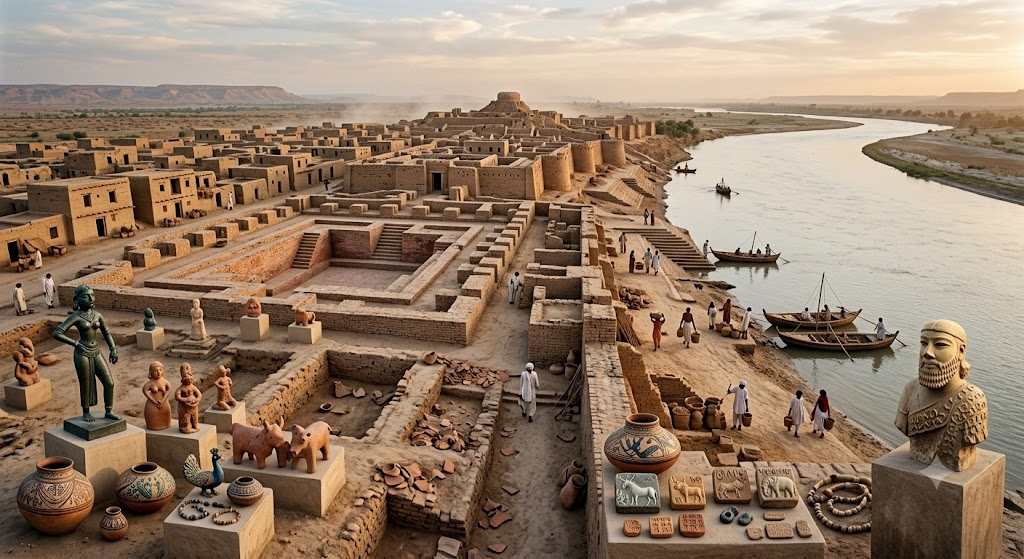
India is the cradle of civilization. Indian culture holds the premier position as the oldest culture in the world. In ancient times, when many civilizations were forest-dwelling nomads, Indians established the Harappan civilization in the Indus Valley… Rivers have played a monumental role in human evolution and the creation of civilization. Rivers provided the elixir of life (Sanjeevani) for humans, birds, and animals alike. They served as vital pathways through dense, trackless forests. This is why the world’s most ancient civilizations developed along riverbanks…
Four major centers of world civilization are recognized:
- The fertile, grain-rich region of the Indus-Ganga-Yamuna – Hindustan – Bharatvarsha
- The fertile basin of the Nile River – Egypt
- The lush region between the Euphrates and Tigris – Mesopotamia
- The abundant basins of the Hoang-Ho and Yangtze – China
Among these, the Indian civilization that flourished along the banks of the Indus, Ganga, and Yamuna is the most ancient and foundational. In the fifth chapter of his book Ignited Minds, former President Dr. A.P.J. Abdul Kalam wrote: “Our core Indian culture is timeless. It predates the arrival of Islam; it predates the arrival of Christianity. You can see that early Christians retained this Indianness with conviction: their married women wear the Mangalsutra and their men wear the Dhoti in the Kerala style.”
Through Hinduism, India gifted the entire world a comprehensive system of social life structured on four fundamental pillars: Dharma, Artha, Kama and Moksha. India provided humanity with a complete way of living through the tradition of Yagnas, the four Ashramas (stages of life), the four Purusharthas (aims of life), sixteen Samskaras (sacraments), conduct, thought, behavior, family life, warm hospitality, and festivals… Because of this, a reflection of Hindu culture can be observed across all religious cultures and civilized societies globally today. Thousands of years ago, when people across the world lived erratic lives driven by disparate mindsets without a clear system of governance or social structure, India gifted the world social organization and the family institution… Notably, Indians have been raised within a vast, interconnected community since ancient times.
This sacred land of India has been nourished by the yoga of yogis, the penance (Tapasya) of ascetics, and the devotional singing (Bhajan) of devout saints. India delivered an unprecedented message to the world: “The ultimate purpose of human birth is the attainment of spiritual welfare.” India is the only nation where people of diverse faiths live together in harmony. Hinduism, Buddhism, Jainism, and Sikhism were all born in India. The famous American author Mark Twain remarked: “India is the cradle of the human race, the birthplace of human speech, the mother of history, the grandmother of legend, and the great grandmother of tradition… In religion, India is the only millionaire.” In this vast country, people speaking a multitude of dialects reside together. This stands as a world record for human diversity coexisting within a single nation. Yet, amid this rich diversity, everyone is woven into the tapestry of a shared culture like birds perched on the same branch. And the heart of every citizen echoes one sentiment: Sare Jahan Se Achha Hindostan Hamara (Better than all the world is our Hindustan).
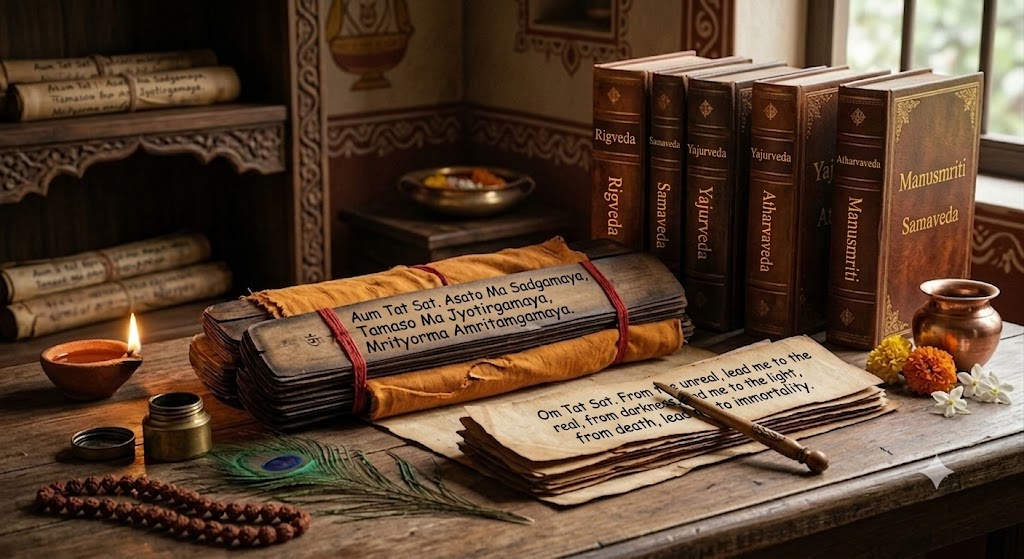
The Vedas represent perhaps the oldest written documentation of human civilization. The Rigveda holds the honor of being recognized as the most ancient religious text, not only in India but in the entire world. Following the Rigveda came the Yajurveda, Samaveda, and Atharvaveda… dividing the eternal knowledge into four Vedas. These scriptures contain the essence of life from its very beginning to its ultimate conclusion. The faith based on the Vedas is known as Sanatana Vedic or Hindu Dharma.
Beyond the Vedas, millions of profound works were authored on Indian soil—including the Upanishads, Sutra Granths, Puranas, Agastya Samhita, Bhrigu Samhita,Charaka Samhita, Sushruta Samhita, Viman Shastra, Paramanu Shastra, anatomy, embryology, Hematology, pharmacology, Kautilya’s Arthashastra,Chanakya Niti, Vidura Niti, Yoga Sutras, Kathasaritsagara,Panchatantra, Hitopadesha, Singhasan Battisi, Vikram-Betaal,Tenali Rama, Shukasaptati, Jataka Katha, Sanskrit Subhashitas, the Tripitaka, Jain Sutras, Siddhanta Shiromani, Rasa Ratnakara, Ashtadhyayi,Samayasara, Lilavati, Vachanamrut, Nishkulanand Kavya and Satsangi Jeevan. These foundational texts continue to serve as pillars for modern advancements across science, technology, and contemporary living… Among the world’s largest and most ancient epics, the Ramayana and Mahabharata hold the supreme place, with the Shrimad Bhagavad Gita imparting a unique message for practical life.
Sanskrit—the world’s most ancient and rich language—originated in India. Renowned worldwide for its structural perfection, Sanskrit is revered as the language of the divine (Devabhasha) and stands as the mother of numerous global languages. Prakrit emerged from Sanskrit, which later evolved into regional dialects, giving birth to a wide array of languages. The practice of writing using scripts — Lipi also originated in India. In ancient India, the Brahmi and Devanagari scripts were widely used. According to researchers, Brahmi is the mother script of Devanagari, Bangla, Odia, Gujarati, Gurmukhi, Tamil, Malayalam, Sinhala, Kannada, Telugu, Tibetan, Ranjana, Nepali, Thai, Burmese, Lao, Khmer, Greek, and many others.
The formal worship of the Divine and the construction of temples (Devagruha) first began in India. The rituals of deity worship were originally practiced thousands of years ago by ancient indigenous tribes, and were later integrated into Aryan culture. During the Rigvedic era, worship was offered to Indra, Yama, Varuna, Surya, and Usha. Over time, magnificent temples were established for congregational prayer, praise, and devotion, allowing this stream of spiritual devotion (Bhakti-marga) to flow across the world. India gifted the world the tradition of celebrating festivals and sacred observances… India is truly a radiant land of vows, festivities, and holy days. Festivals like Holi, Diwali, Janmashtami, Ram Navami, Shivratri, Ganesh Chaturthi, Navratri, and Dussehra are celebrated here and known worldwide. Additionally, India gave the world Karwa Chauth—a sacred observance where a wife fasts and prays for the longevity and well-being of her husband. Such a dedicated observance is unique to Indian culture.
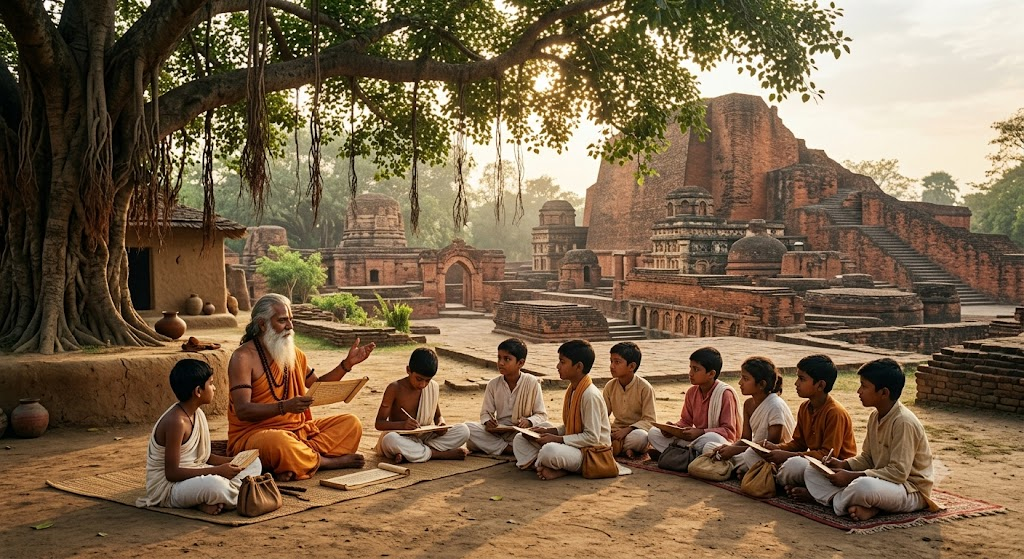
In the realm of education, India served as the “Principal of the World”… The world’s first university was established in India—Takshashila University. While much of the world was taking its initial steps toward basic education, Takshashila hosted over 10,500 students from around the globe studying more than 60 complex subjects. Similarly, ancient India’s Nalanda University was revered as a premier seat of learning and academic excellence.
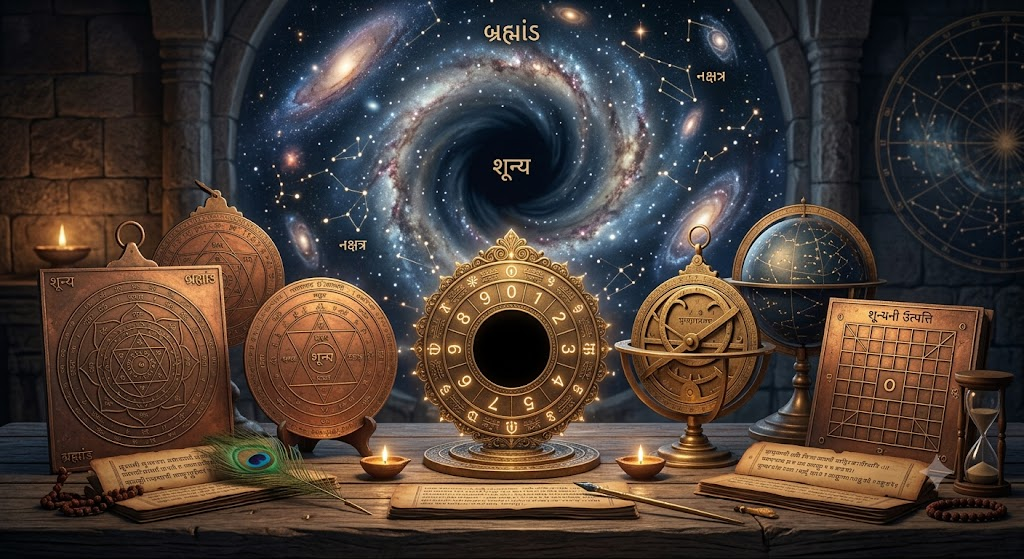
India taught the world how to count and perform mathematical calculations. India gave humanity the concept of zero (0) and invented the numeral system from 1 to 9. Ancient Vedic seers developed Vedic Mathematics based on Vedic mantras. Thousands of years ago, the people of the Harappan civilization understood arithmetic and utilized binary principles. Concepts such as the value of $\pi$, algebra, trigonometry, arithmetic, and calculus all had their origins in India. The decimal system and the place-value system were developed here, and the fundamental geometric theorem now known as the “Pythagorean Theorem” was first formulated in ancient India.
The first dawn of astronomy occurred in India… While many parts of the world remained unaware of cosmic dynamics, ancient Indian seers were calculating planetary movements beyond the Sun and Moon. India provided the world with knowledge regarding the motion of the Sun and Moon, the circumference of the Earth, solar and lunar eclipses, and gravity. Discoveries that the Earth is spherical, rotates on its axis, revolves around the Sun, and takes 365.258756484 days to complete an orbit were all made in India.
Countless esoteric arts and sciences were born in India—including Mrit-Sanjeevani Vidya, Prana Vidya, astrology, palmistry, Vastu Shastra (architecture), hydrology, archery, Ashta Siddhis (eight mystical accomplishments), Nav Nidhi, hypnotism, occult sciences, out-of-body experiences, knowledge of reincarnation, and foresight (Trikaldarshi).
In addition, numerous arts and crafts originated here—linguistics, writing, vocal music, dance, drama, instrumental music, architecture, painting, sculpture, culinary arts, literature, textile weaving, perfumery, needlework, embroidery, carpentry, gemology, lapidary arts, Kalaripayattu (martial arts), folk theater, and mimicry.
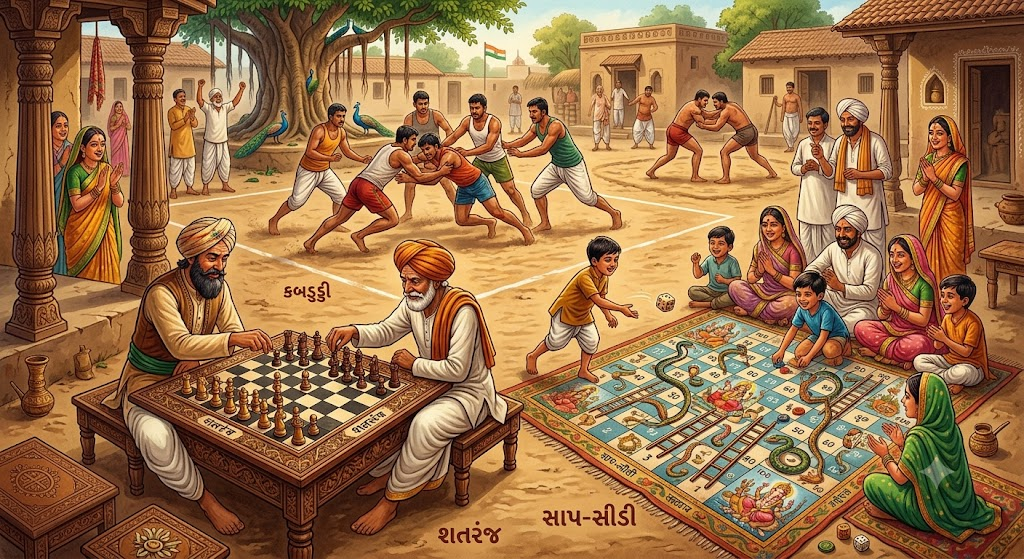
Games and sports also flourished in the courtyards of India. Several Indian sports have attained global prominence today. The game of Chess originated from the ancient Indian game of Shatranj. Snakes and Ladders, Ludo (Pachisi), Kabaddi, Kho-Kho, Hockey, chariot racing, boat racing, swordsmanship, archery, wrestling, swimming competitions, javelin throw, hide-and-seek, tag, kite flying, and rope jumping all trace their origins back to India.
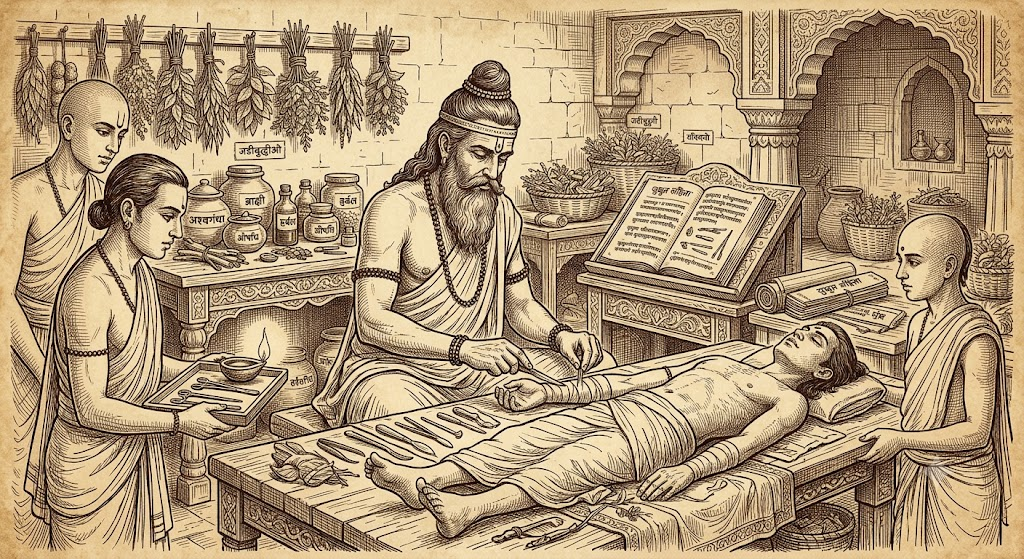
Indian Ayurveda is the world’s most ancient system of health and medicine. Ancient Indian medical texts document deep knowledge of human anatomy, embryology, digestion, metabolism, physiology, etiology, genetics, and immunology. The use of anesthetics was well established in ancient Indian medicine. Complex surgical procedures—including organ transplants, C-sections, cataract surgeries, bone fracture settings, plastic surgery, and cranial/brain surgeries—were pioneered in ancient India.