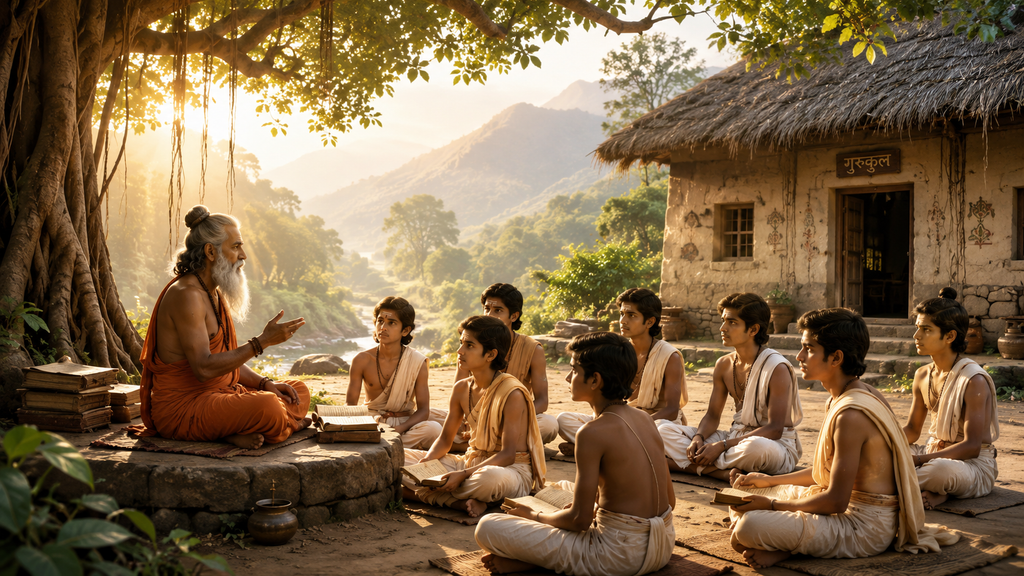
In various parts of the Vedas, the objectives of education of that era have been described in diverse ways. Casting a high, bird’s-eye perspective over all these objectives yields one solid essence:
विद्याञ्चाविद्याञ्च यस्तद्वेदोभयं सः ।
अविद्यया मृत्युं तीर्त्वा विद्ययाऽमृतमश्नुते ॥ (शुक्ल यजुर्वेद, काण्व शाखा… ४०/११)
“Attainment of immortality comes through knowledge (Vidya).”
The autograph of this immortality cannot be obtained without being liberated from death. To gain liberation from death, it is necessary to know and understand the true nature of the Supreme Being. Drinking the cup of divine realization brings the deep satisfaction of immortality and grants freedom from numerous sorrows such as birth, death, and existence in the womb.
That Supreme Being…
“सत्यं ज्ञानमनन्तं ब्रह्म” is Truth, Knowledge Incarnate, and Infinite… and for this reason, the prayer has been offered:
असतोमा सद्गमय । तमसोमा ज्योतिर्गमय । मृत्योर्मामृतङ्गमय । (शतपथ ब्राह्मण…१४/१/३/२८) “O Lord, lead us from untruth to truth, from darkness to light, and from death to immortality…”
Therefore, attaining the knowledge of the Supreme Being was the primary objective of Vedic Gurukul education.
In addition, the union of education with noble intellect (wisdom) is essential in life. When an educated person misuses their intellect, it automatically bestows an award of goodness upon the uneducated (“Illiterate people are better than this”).
Hence, in the Rigveda, it is said:
‘शं सरस्वती सह धीभिरस्तु’ (ऋग्ग्वेद:… ७/२५/११)
Accordingly, the completeness and holistic nature of education exist only when it fulfills three goals:
- Self-reliance, 2. Character/Personality Building, and 3. Development of Social Harmony.
Vedic scholars believed that: “Through education, every individual can develop their physical, mental, intellectual, and spiritual powers to achieve the true happiness of life in both this world and the afterlife.” Thus, along with education, character building was a supreme objective of Vedic Gurukul education.
Historian Anant Sadashiv Altekar wrote in his book Education in Ancient India: “Attainment of God-consciousness through devotion and religious feeling, character building, personality development, fulfillment of social duties, progress in social efficiency, and the preservation and propagation of national culture were the main objectives and ideals of Vedic education in ancient India.” All these objectives were completely realized in the Vedic-era Gurukuls.
1. Attainment of Brahm (God-Realization) through Devotion and Religiosity:
Ancient India was constructed not primarily on political, economic, or social grounds, but on religious and spiritual foundations. In the book A History of Sanskrit Literature, foreign scholar Macdonell writes: “From the period of the creation of the oldest Vedas, Indian literature has borne the stamp of religion.”
Ancient Indians considered education that merely catered to the pursuits of material gain (Artha) and desire (Kama)—providing only physical or worldly comfort—not as true knowledge, but as ignorance (Ajñana). Therefore, for eternal peace, happiness, and bliss, they linked the third pursuit, Dharma (Righteousness), alongside Artha and Kama. To nurture this pursuit of Dharma, the society of that time gave complete priority to spirituality and religiosity in education. Thus, fostering devotion to God and a sense of righteousness in the heart-temple of the student was the main objective of Vedic Gurukul education. Through various rites of passage (Samskaras) within every discipline of education, observance of vows by students, regular morning/evening prayers (Sandhyavandanam), and the celebration of religious festivals, the roots of devotion and religiosity were deeply strengthened in student-disciples.
Devotion and religiosity fill life with spiritual enthusiasm. Spirituality means the quest for the Soul/Self. This spiritual knowledge grants liberation at the end of life and peace during life. Achieving peace is the ultimate aspiration of human existence. Hence, the reflection of this yearning for peace is captured in numerous Vedic hymns. The famous peace chant from the Shukla Yajurveda states:
द्योः शान्तिरन्तरिक्षं शान्तिः पृथिवी शान्तिः शान्तिरापः शान्तिरोषधयः शान्तिः वनस्पतयः शान्तिः विश्वेदेवाः शान्तिः ब्रह्म शान्तिः सर्वशान्तिः शान्तिरेवशान्तिः सामाशान्तिरेधि ॥ (शुक्ल यजुर्वेद… ૩૬/૧૭)
In this mantra, God is prayed to: “May the sun, the sky, the earth, the waters, the medicinal plants, the vegetation, all wise beings, Brahma, and all things distinct from these remain at peace; may that peace come and dwell within me, and may the peace that calms the entire universe itself become tranquil.” What a marvelous vision! Therefore, to attain peace and liberation, students were imparted spiritual knowledge within the pious and devotional atmosphere of the Gurukul. In this way, realizing God (Brahma-prapti) by attaining peace during life and liberation at the end of life through devotion and righteousness was a vital objective of Gurukul education.
2. Character Building:
Indians of the Vedic era firmly believed that without character building, an edifice of intellectual development built in its absence could not withstand the storms of life. For this reason, the second aim of Vedic Gurukul education was student character building. To achieve this objective, students were taught moral conduct (Sadachara).
आ नो भद्रा: क्रतवो यन्तु विश्वत:। (ऋग्वेद… १/८९/१)
“May noble thoughts come to us from every direction.”
According to this verse of the Rigveda, student-disciples were inspired to gather benevolent thoughts from everywhere with complete positivity to shape righteous character. Furthermore, in the courtyard of the Gurukul, the sapling of character was continuously nourished with the waters of examples from the greatest personalities. Thus, character building was a distinct objective of Gurukul education.
3. Personality Development:
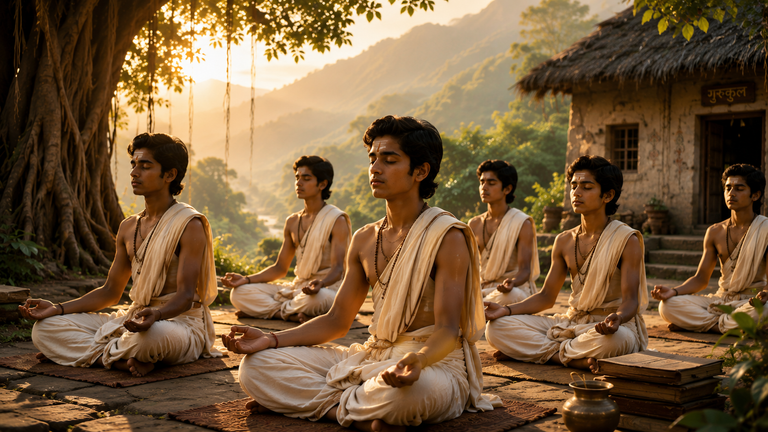
The third objective of Vedic Gurukul education was the overall development of the student’s personality. This personality development did not consist merely of today’s superficial talk; rather, the objective of Gurukul education was to reveal a grand personality through the realization of self-control, self-confidence, and self-respect in the mirror of experience.
In Gurukul education, personality development meant diving deep into one’s inner self—a realm where even great “mountain masters” might fail. Scaling heights in the world is easy, but taking a plunge into the ocean of the Self is difficult. Mountain-climbing humans who ascend worldly paths can achieve success, but they often cannot digest failure. On the other hand, experienced souls who have delved deep into their own personality know how to digest both success and failure. Through a strong personality built by the Gurukul, a student-disciple could attain the completeness of life. Moreover, starting from personal development, this journey inspired every student to become a Universal Human (Vishwa-manav).
Hence, in the eighth mandala of the Rigveda, a powerful and noble term is given:
यस्य ते विश्वमानुषः ॥ (ऋग्वेद… ८/४५/४२)
Today, people across the world are divided by barriers of caste, language, sect, religion, and nationality, becoming weak and distressed. However, our ancient sages envisioned the Vishwa-manav thousands of years ago. Rishi Trishoka presented a noble thought in the Rigveda that instead of fighting and perishing, people across the global community should unite as universal humans and serve one another. Therefore, the grand vision at the foundation of Gurukul education was that through personal development, every human should transcend basic human limits to become a universal citizen. From personal development to global development was the goal of Gurukul education.
4. Fulfillment of Personal and Social Duties:
In Vedic society, special attention was paid to personal and social duties. Thus, the fourth objective of Vedic Gurukul education was to bring perfection to student-disciples in fulfilling their personal and social responsibilities. To this end, students were instructed on how to perform their duties as sons, husbands, and fathers, as well as how to become ideal citizens of society. To nurture love toward every human being in society alongside one’s family, verses of the Rigveda echoing the spirit of universal brotherhood resounded from the unselfish streams of the Gurukul’s mountain peaks:
पुमान् पुमांसं परि पातु विश्वतः ॥ (ऋग्वेद… ६/७५/१४)
Meaning: “Humanity must protect humanity in every way, all across the world…”
If every human being on Earth began protecting every other human being through the spirit of universal brotherhood and ‘Vasudhaiva Kutumbakam’ (the world is one family) expressed in this Rigvedic verse, what would happen? Universal peace would be established! Through these profound messages of the Vedas, students in the Gurukul were taught the dignity of every human being. As a result, they became conscious of their duties toward all people. Furthermore, during householder life (Grihastha ashrama), they welcomed guests throughout their lives with their earnings and offered help to the poor and suffering.
5. Development of Social Skills:
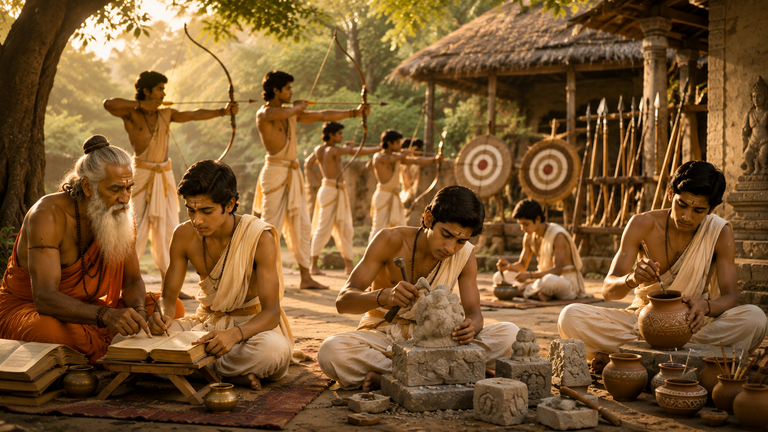
The fifth objective of Vedic Gurukul education was to increase overall happiness through the development of social skills. This objective was achieved by arranging education in various scriptures, professions, and industries within the Gurukul. Along with mental development, students were provided vocational training useful for their future lives.
Generally, in almost all Gurukuls, students were given complete training in occupations suitable to their aptitudes and stages of life. Consequently, becoming efficient in their professions, they contributed to the well-being of all living beings under the principle of “सर्वभूत हित: रता:” (dedicated to the welfare of all beings).
Additionally, knowledge of various arts was imparted in the Gurukul. Formed through fine skills and arts within the arena of the Gurukul, the student-disciple could live a happy life like an emperor and bring happiness to others.
6. Preservation and Propagation of National Culture:
Ancient Indians regarded it as their supreme duty to ‘protect the nation through literary, cultural, and professional traditions.’ Thus, the sixth important objective of Gurukul education was the preservation and spread of national culture. Memorizing the Vedas, mastering traditional crafts passed down by parents, and utilizing acquired knowledge and education for the nation formed the bedrock of Gurukul education. In the soil of the student’s life, seeds of dedication to the defense of national culture were sown using the waters of Vedic wisdom.
अक्षैर्मा दीव्यः कृषिमित्कृषस्व वित्ते रमस्व बहु मन्यमानः॥ (ऋग्वेद… १०/३४/१३)
Meaning: “Blessed is this holy land! It has freed us from the necessity of violence.”
Cave-dwelling humans used to survive by eating meat; however, ever since humans learned agriculture, they stopped killing animals and birds for food. Expressing gratitude toward the land and agriculture while advocating non-violence, this mantra highlights the importance of preserving national wealth and carrying forward national culture. As a result, the significance of national wealth and the preservation of national culture were deeply realized in the hearts of student-disciples.
Thus, alongside physical, mental, intellectual, and spiritual progress, the primary purpose of education in these Vedic Gurukuls was to make every student useful in preserving and spreading national culture.
7. Environmental Consciousness:
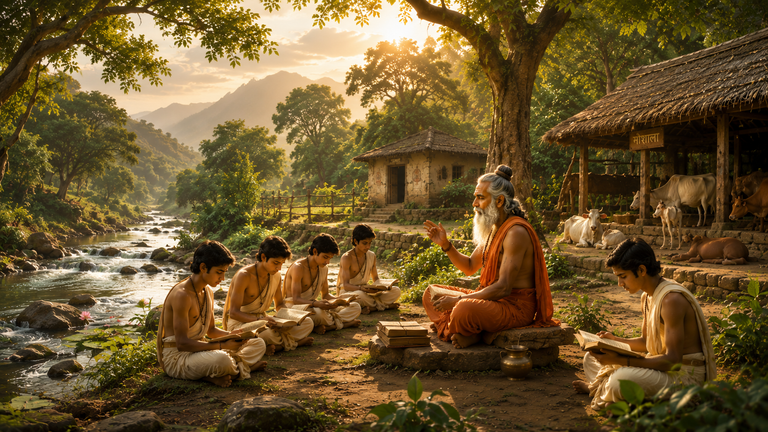
In addition to the above objectives, according to some scholars, the importance of nature and the environment was also granted a prominent place in the goals of ancient Gurukul education. Through this, the significance of nature was nurtured in the lives of student-disciples. Today, we live in an era of severe pollution where every thoughtful individual is concerned about environmental protection. Yet, thousands of years ago, our visionary sages expressed deep love for the Earth and nature. Thousands of mantras in the Vedas offer high praise and prayers to elements of nature such as the Earth, Sun, rain, mountains, rivers, trees, dawn, and moonlight. Elements of nature like the Sun, Moon, fire, water, and air were revered as divine entities. The Earth, rivers, and cows were elevated to the status of mothers. Furthermore, all living beings were considered friends…
द्रते दंह मा मित्रस्य मा चक्षुषा सर्वाणि भूतानि समीक्षन्ताम्।
मित्रस्याहं चक्षुषा सर्वाणि भूतानि समीक्षे।
मित्रस्य चक्षुषा समीक्षामहे॥ (यजुर्वेद… ३६/१८)
Meaning: “May all beings look upon me with the eyes of a friend. May I look upon all beings with the eyes of a friend. May we all look upon one another with the eyes of a friend…”
Here, alongside the ideal of universal brotherhood where humans become friends to one another, an ideal vision of environmental protection was established by making all non-human creatures friends as well.
The first hymn (Sukta) of the twelfth book (Kanda) of the Atharvaveda is titled the Prithvi Sukta (Hymn to the Earth), containing 63 mantras. Rather than viewing the Earth as inert matter, the sage expresses the devotion due to a living mother—a concept that reinforces today’s principles of biodiversity. Not only this, but these mantras also provide a vision of prosperity and balanced development through the true worship of the Earth.
The sage says:
“माता भूमिः पुत्रोडहं पृथिव्याः पर्जन्य पिता स उ नपिपर्तु” (अथर्ववेद… १२/१/१२)
Meaning: The Earth is my mother and I am her child. Rain (Parjanya) is the father who nurtures us.
With the nectar-drops of rain, the Earth comes alive. Fruits, flowers, grain, water, milk, and ghee—all of these are blessings of Mother Earth, are they not? How simple yet profound this realization is!
“The Earth is my mother, and I am her child,
Rain pours from the sky, nourishing the father of the world!
Healers knew her, whom Lord Hari held aloft,
The king of gods protects her, as streams of milk flow endlessly!
Oceans, rivers, lakes, fields, forests, and gardens,
Grains, water, fruits, flowers, and vital breath for all time!
Creatures of water, land, and sky—she breathes life into all,
The foundation of truth, penance, education, initiation, and every sacrifice!
The Earth is my mother, and I am her child!…”
What a wonderful vision the sages possessed! The Gurukul tradition insisted on savoring the fragrance of love for the Earth—the supreme manifestation of the Divine—and from that tradition, the Gurukul blossomed. Consequently, students studying in the Gurukul developed deep respect for animals, nature, the environment, and the entire Earth. Treating every element of nature as a part of the Divine, they automatically committed themselves to its protection.
Now, here is a timeless, golden rule worth writing on the first page of a personal diary: The best action is not one that merely yields the best result, but the best action is one whose purpose is the supreme. It is precisely because of these supreme objectives of education that the Gurukul system stands out as truly extraordinary.
To fulfill these grand objectives and ideals of education in the Gurukul, the educationalists of the Vedic era and the Acharyas (sages) developed a powerful, specialized methodology of Gurukul education, enabling an ordinary human being to set out on a grand journey toward becoming an extraordinary, universal human.