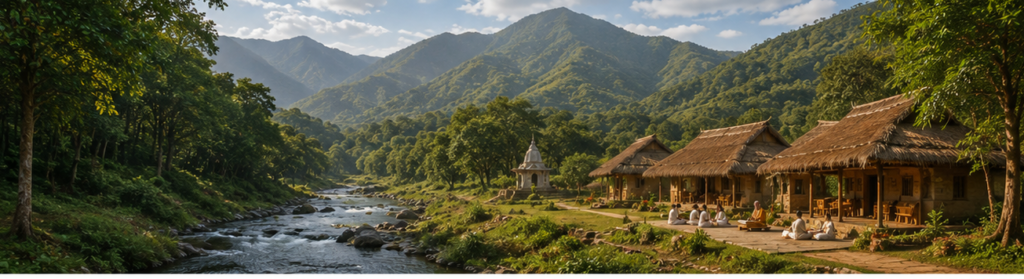
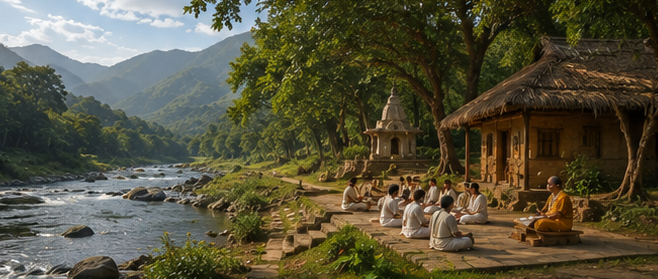
Located in the jungle, a short distance away from the city, these Gurukuls (traditional academies) were bringing well-being to the entire world. Describing the live location of these Gurukuls, waves arose in the ocean of literature: “In the cozy, secluded lanes of nature, unique were those schools of the saints…”
Under the canopy of the forest, these Gurukuls became abodes of spirituality. Regarding such spiritual hermitages, the Father of the Nation, Mahatma Gandhi, said: “An ashram is not merely a place of penance, a cave for ascetics and monks, an encampment, or a dry code of Hindu Varna-dharma; it is a sacred land of collective social ideals…”
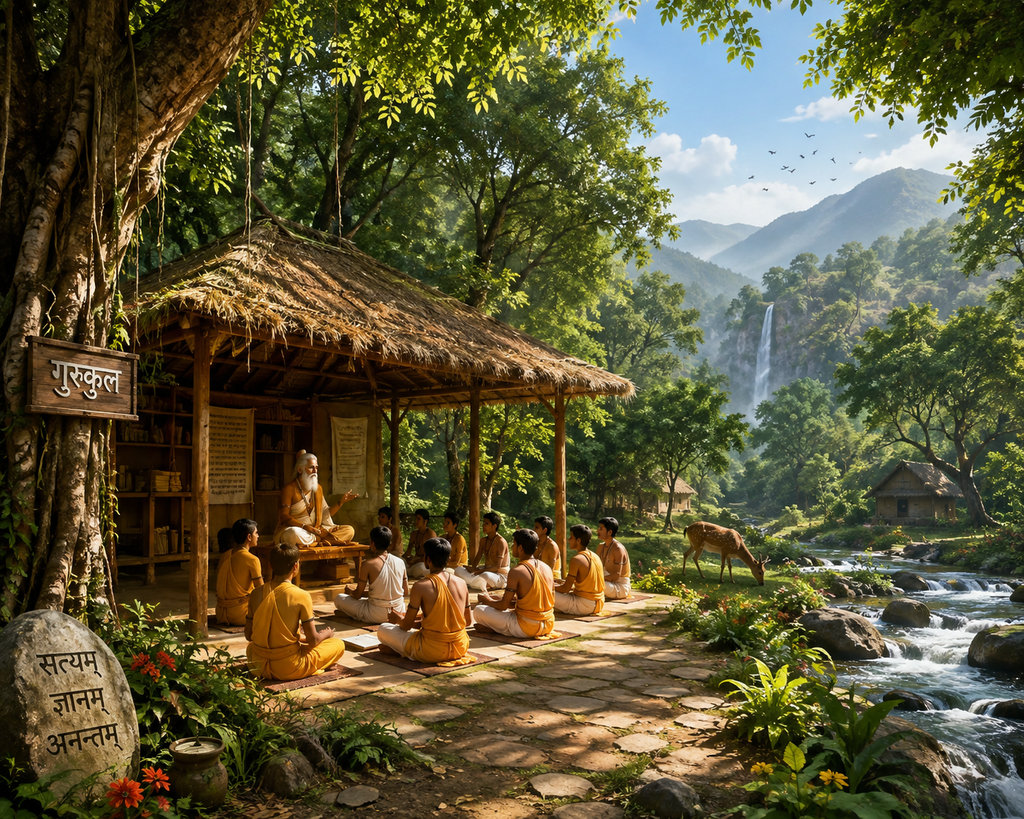
Even in the midst of the forest, these Gurukuls offered a glimpse into the essence of life.
These Gurukuls were situated in the lush greenery of the forest.
A land covered with dense trees and tangled vegetation is what defines a forest or jungle.
A cluster of trees and creepers surrounded by birds and animals is what defines a forest or jungle.
Indian culture was nurtured in the cradle of forests. Nobel laureate Rabindranath Tagore described Indian culture as the “Culture of the Tapovan” (hermitage of penance).
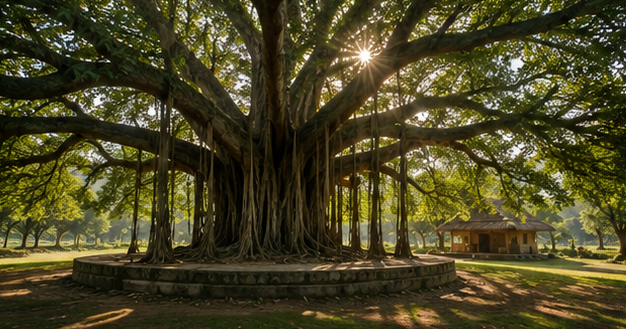
The foundation of a forest or jungle is its trees and vegetation. Among the living beings born on Earth, vegetation is the elder sibling, and human beings are the younger. Vegetation is as ancient as it is omnipresent. In every corner of the Earth, vegetation graces the land in one form or another. From tender blades of grass to massive banyan trees, flora has flourished in all shapes and sizes. Since ancient times, humans have shared a deep, vital bond with trees and vegetation—an intimate relationship woven into human life itself. From the cradle to the funeral pyre, and from a child’s toy to a grandfather’s walking stick, the domain of trees extends everywhere. This is precisely why trees are human friends. Humans began worshiping trees and plants, honoring them as a great element of life. That is why, in Indian culture, trees ceased to be merely useful objects and became revered as divinities, earning a prominent place in tree worship across many of our festivals.
The glory of trees is sung in the Vedas. In the Shvetashvatara Upanishad, the tree is given as an allegory for the Cosmic Being (Vishwa Purusha). Trees give rest to human eyes and bring satisfaction to the heart. Looking at their cool shade, sweet fruits, blossoms that perfume the atmosphere, vibrant colors, and the varied patterns of their branches and leaves, it feels as though trees are a swaying ocean of beauty, color, and essence. A tree is like the music of the earth, the beauty of the seasons, and poetry spread across the sky. A tree is truly the lifeline of the entire creation—because trees absorb vast amounts of carbon dioxide from the atmosphere and generate oxygen, blending it back into the air. Trees lower the atmospheric temperature. India boasts one of the richest varieties of trees. The leaves of trees purify the air through photosynthesis. Their roots prevent soil erosion, and they stop deserts from expanding. The roots and leaves of trees are used as medicine, while the leaves of certain trees are used to make eco-friendly leaf plates and bowls (padiya-patrala). Trees help bring rain by cooling the clouds. In their cool shade, animals, humans, and travelers find rest. The most remarkable aspect of trees is that no part of them goes to waste—fruits, seeds, flowers, leaves, roots, and trunks are all useful to mankind in one way or another.
Furthermore, trees are the glory of the earth. An earth without trees looks as barren as a head without hair. Trees are like saints, for a tree offers fruit even to the person who hurls a stone at it. According to mythological lore, Lord Shiva drank the poison that emerged from the churning of the ocean (Samudra Manthan), saving the gods so that everyone could receive the nectar (Amrit) that followed. Every moment, trees perform a great act of grace like Lord Shiva. They consume various poisonous gases and pollutants, bestowing pure air as nectar along with countless life-sustaining gifts to the world. Hence, sentiments like “Vasudeva resides in the tree”, “Vishnu resides in the tree”, and “Ranchhod (God) resides in the sapling” developed in Indian culture. Offering their entire lives for the welfare of others, trees say:
“We came as royal poinciana (Gulmohar), overflowing with charm;
We stood firm as shade, and we will depart as fallen leaves;
We will remain here as branches, living forever as your companions.”
It was in the embrace of such benevolent trees that Gurukuls flourished.
In the lap of the forest—a haven for diverse trees and plants—these Gurukuls thrived.
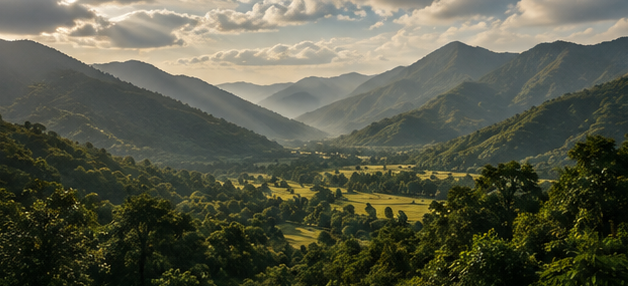
They were nestled at the foot of mountains.
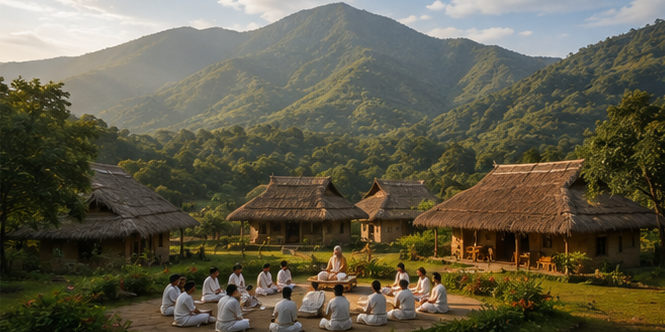
A mountain is a landform on the Earth’s surface that rises significantly higher than its surrounding area. Mountains mostly extend in ranges, though they are sometimes found as isolated geographical features… for example, the Aravalli and the Himalayas are mountain ranges, whereas Pavagadh and Girnar are individual peaks. Rising abruptly above their surroundings, mountains stand out distinctly. If natural beauty has an origin and an end, it is the mountain… a mountain is a beautiful gift of nature. Mountains are the cradle of rivers. The winding paths on a mountain with valleys alongside are the true signatures of natural scenery. A mountain is an embodiment of benevolence, hosting a variety of medicinal herbs and plants. Teaching the ideal of high living, we even have a musical scale in our classical tradition named Raag Pahadi, inspired by the mountains. A mountain is a platform for spirituality… providing shelter for yogis, meditators, and ascetics to practice their devotion. In India, most temples are situated on hills or mountains. A mountain is a bridge of culture—and a bridge is that which connects. When someone told Rabindranath Tagore, “The Himalayas separate China and India,” Tagore instantly replied, “The Himalayas connect China and India; they do not divide them.”
The land that touches the feet of a mountain earns the title of a foothill (Taleti)… and it was in these foothills that Gurukuls flourished.
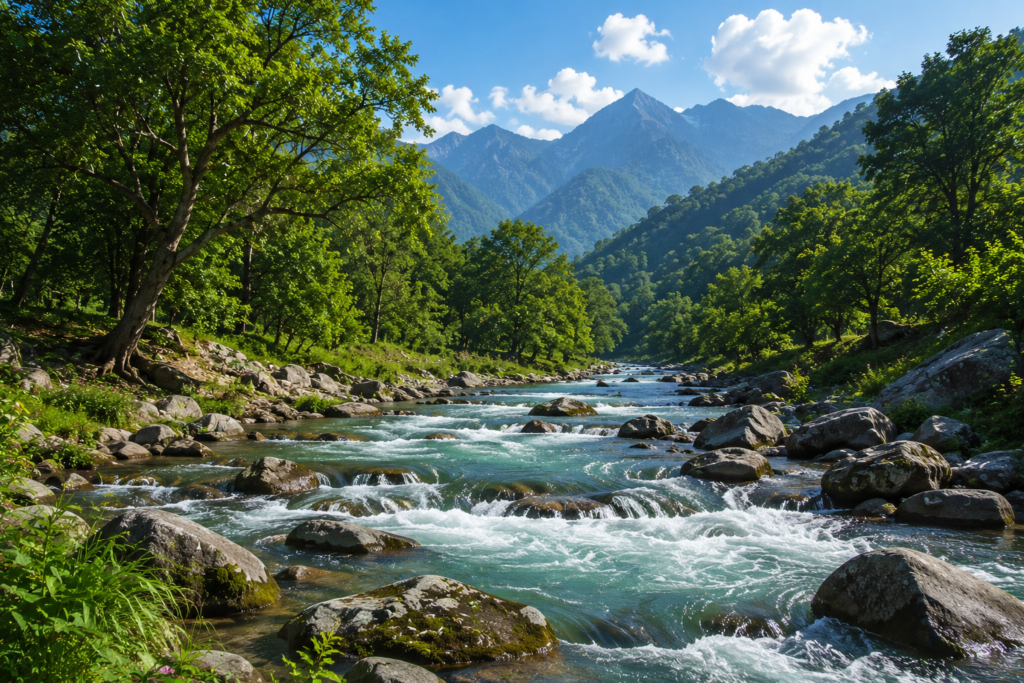
These Gurukuls were established along riverbanks. A river is a stream of water originating from mountainous terrains as small or large springs, flowing continuously down a slope through the foothills, and ultimately merging into the sea. Through erosion, transportation, and deposition, rivers play a vital role in shaping the Earth’s surface on a large scale. Every river flows from high-altitude land toward lower regions, though its path and curves shift according to the local landscape. Life on Earth originated in water; in fact, water is the primary condition for life. That which flows endlessly as a source of water is called a river. A river is free-spirited; it is never bound, always flowing with a rhythmic gush. When the fatherhood of the mountain and the motherhood of the valley blend into one another, a river begins to flow. Watching a river leap and splash out of the mountains like a laughing stream, poets have written:
“There is no song like a river, no melody like a river;
In a river, so many civilizations come together…”
In our tradition, it is said: “पिबन्ति नद्यः स्वयमेव नाम्भः”—meaning rivers do not drink their own water, but offer it for the well-being of others. To us, rivers are not mere physical entities, but living beings; that is why we address rivers as mothers (Lokmata). India is the only country in the world that reveres rivers as mothers. To speak of a river is to speak of abundant prosperity—where there is a river, there will be prosperity. That is why Kakasaheb Kalelkar named rivers Lokmata (Mother of the People) and Jivanleela (The Play of Life). In India, numerous festivals and celebrations are observed in the lap of Mother River. In the waters of literature, rivers have received more opportunities for a holy dip than even the vast oceans…
“Rather than those great oceans that carry unknown,
wondrous secrets within their depths,
Dearer to me is my familiar, beloved river Nira.”
In our country, rivers are considered not just useful, but sacred. Rivers flowing across multiple states or nations transcend national and international border disputes. Towns flourished along riverbanks, and cities, regions, and states were named after these rivers. For example, the land of five rivers—Sutlej (Satadru), Chenab (Chandrabhaga), Beas (Vipasa), Jhelum (Vitasta), and Ravi (Iravati)—is known as Panjnad or Punjab.
As rivers flow along, they seem to say:
“I am a river, crafting my existence drop by drop;
Moving forward is life—this is what I teach everyone as I flow.
Whether the journey is long or the destination near, I never tire;
When obstacles cross my path, I never lose my poise.”
It was alongside the gentle music of these flowing waters that the Gurukuls were located. At the sacred confluence of the forest, the mountain, and the river, these Gurukuls became one with the environment. In the lush green garden of the forest, the flower of the Gurukul bloomed. Joy and well-being blossomed in the wilderness… all because of the Gurukul.