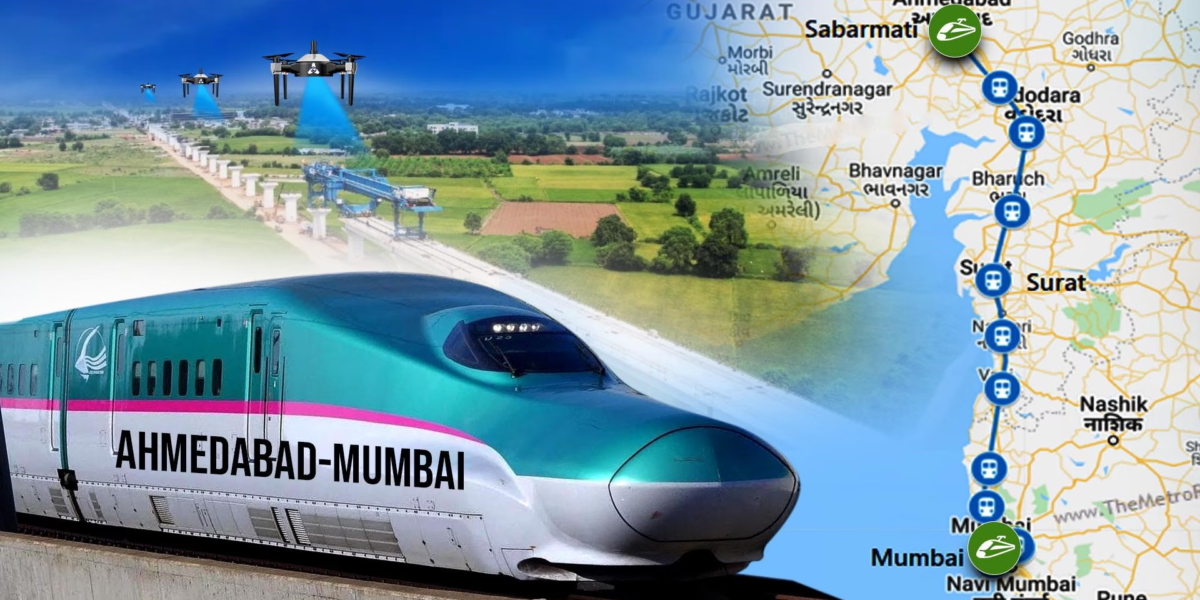
India’s upcoming Mumbai–Ahmedabad Bullet Train corridor is being equipped with a dedicated Early Earthquake Detection System, designed to protect passengers and railway infrastructure in the event of seismic activity. The system will use 28 seismometers installed along the 508-km high-speed rail corridor and at selected earthquake-prone locations in Gujarat and Maharashtra.
The safety system is particularly important because the train is designed to operate at speeds of up to 320 kmph, with a design speed of 350 kmph. At such speeds, even a few seconds of early warning can be critical for initiating emergency safety measures.
How will the earthquake detection system work?
The system is based on the principle of detecting the primary, or P-waves, generated when an earthquake occurs. P-waves travel faster than the stronger and potentially more damaging seismic waves that follow.
When the seismometers detect seismic activity that crosses the prescribed operational threshold, the system can automatically shut down traction power in the affected section. The bullet trains operating in that section can then detect the power interruption and activate their emergency braking systems.
In simple terms, the safety chain will work like this:
Earthquake → P-wave detected → Seismometer sends signal → Traction power shut down → Train detects power loss → Emergency braking activated.
The objective is to initiate this sequence as quickly as possible, giving trains an opportunity to slow down or stop before stronger ground motion reaches the affected section. However, the system is an early-detection and response mechanism, not a system that predicts earthquakes.
Where will the 28 seismometers be installed?
According to the Ministry of Railways, 22 of the 28 seismometers will be installed along the high-speed rail alignment, including at traction substations and switching posts. Another six sensors will be located inland in earthquake-prone areas identified through seismic studies, historical earthquake data and microtremor testing.
The planned network includes 16 seismometers in Gujarat and 12 in Maharashtra. Gujarat locations include areas around Vapi, Bilimora, Surat, Bharuch, Vadodara, Anand, Mahemdabad, Ahmedabad, Adesar and Old Bhuj. Maharashtra locations include areas around Mumbai, Thane, Virar, Boisar, Kheda, Ratnagiri, Latur and Pangri, according to the Ministry’s July 2026 release.
This means cities along the Gujarat section—including Bharuch and Ahmedabad—will be part of the seismic monitoring network.
Why is this important at 320 kmph?
The Mumbai–Ahmedabad High-Speed Rail corridor will be India’s first dedicated high-speed rail corridor. It will cover approximately 508 kilometres and is designed for an operational speed of 320 kmph. The journey between Mumbai and Ahmedabad is planned to take around two hours, depending on the service pattern.
At conventional railway speeds, a train may have more time to respond to a developing emergency. A high-speed train, however, covers a considerable distance every second. Therefore, the bullet train’s safety architecture relies heavily on automatic detection, signalling, power control and emergency braking, rather than depending solely on human reaction.
The earthquake system is consequently being integrated into the broader high-speed railway infrastructure rather than functioning as an isolated warning device.
The technology has Japanese Shinkansen roots
The earthquake protection approach draws on technology and operational practices associated with Japan’s Shinkansen high-speed rail system, a country where earthquake preparedness is an essential part of railway safety.
The Indian system is being developed specifically for the Mumbai–Ahmedabad corridor, taking into account the seismic characteristics of the areas through which the railway will pass. The location of the additional inland sensors was determined using seismic surveys and soil-related studies.
It is not only earthquakes: the corridor has multiple safety-monitoring systems
Earthquake detection is only one part of the safety infrastructure planned for the bullet train corridor.
The project also incorporates systems to monitor wind conditions along sections exposed to strong winds. The government says 14 locations—nine in Gujarat and five in Maharashtra—will have anemometers to continuously monitor wind speed and direction. When wind speeds reach specified thresholds, operational measures, including speed regulation, can be introduced.
The railway’s electrical infrastructure is also being developed around an advanced 2×25 kV overhead traction system, designed to provide a stable power supply for trains operating at speeds of up to 320 kmph.
What happens if an earthquake occurs while the train is running?
The important point is that passengers would not be expected to manually react to the first indication of an earthquake.
The detection system is designed to automatically initiate the safety response. Once seismic activity is detected and the relevant threshold is reached, power to the affected section can be shut down and emergency braking can be activated.
The exact stopping distance and time would depend on factors such as the train’s speed, location and braking conditions. Therefore, it would be inaccurate to describe the system as guaranteeing that a train will instantly stop the moment an earthquake begins. Instead, its purpose is to detect seismic activity as early as possible and automatically initiate protective action.
When will India’s Bullet Train begin operations?
The Mumbai–Ahmedabad corridor is currently under construction, with civil works, track laying, electrification and other systems progressing across different sections.
The government has stated that the first high-speed rail service is expected to begin in August 2027, with the initial operational section planned between Surat and Vapi. The complete corridor will connect Mumbai and Ahmedabad across Gujarat, Maharashtra and the Union Territory of Dadra and Nagar Haveli.
The project therefore represents more than simply introducing a faster train. It is also bringing a combination of high-speed signalling, automated safety systems, seismic monitoring, advanced electrification and dedicated railway infrastructure to India’s rail network.